Archive

Turkey

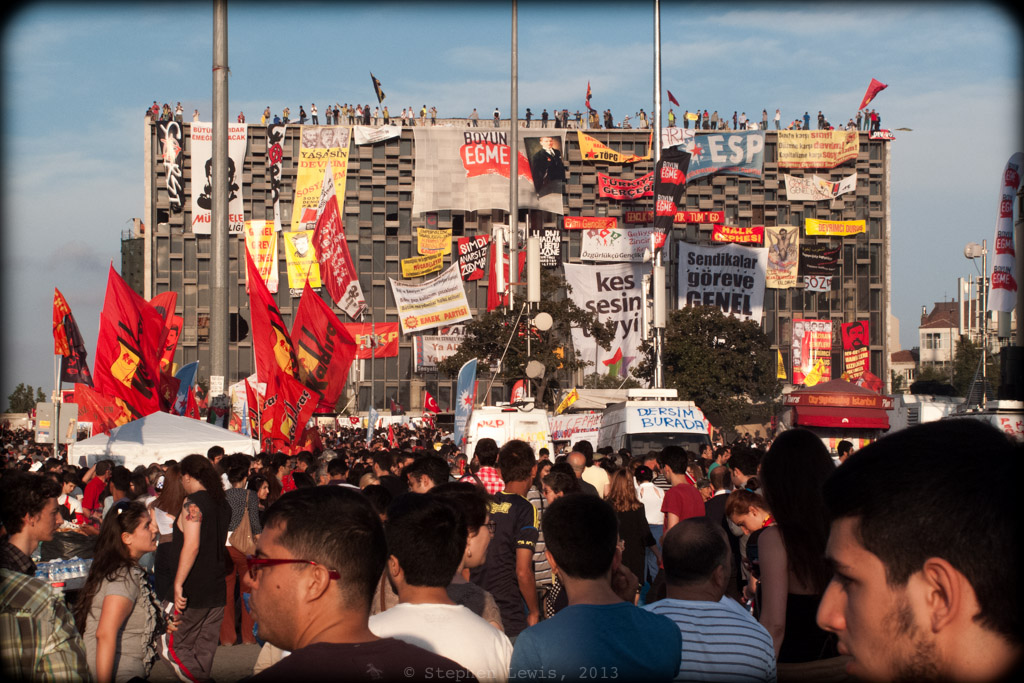
Atatürk Cultural Center, Taksim Square, Istanbul, occupied and bedecked with banners of left wing groups, early-June 2013. (Canon G10) (Click on photo for larger image.)

Atatürk Cultural Center, Taksim Square, Istanbul,  bedecked with banners of left wing groups, Gezi Park occupation, early-June 2013. (Canon G10) (Click on photo to enlarge image.)

This past Saturday night, police once again ran amok in Taksim Square, Istanbul, using tear gas and high-pressure streams of chemically tainted water to drive away protesters.  The attack was minor, however, in comparison with the police’s violent ejection of occupiers and visitors to Gezi Park the Saturday before and their night-long violent siege of Taksim five days earlier.

A Change of Banners

During the two-week-long occupation of Gezi Park, adjacent Taksim Square was a locus of protest for left-wing demonstrators, many of them representatives of fragmented parties driven   ideologies more than  constituencies. As part of the Gezi occupation, a group of protesters took over the long-abandoned Atatürk Cultural Center building, a 1960s structure fronting on Taksim.  The steel-lattice-covered facade of the Atatürk Center made a perfect multistory bulletin-board for the banners of revolutionary sub-sects.  The first act of the Police upon clearing the Center of occupiers was to remove their banners and replace them with a triptych of a giant prim portrait of Atatürk flanked by two equally immense Turkish flags.  This ensemble conspicuously lacked the immense portrait of Turkey’s Prime Minister that is usually hung alongside that of Atatürk at the his outdoor rallies and as a backdrop to his lengthy television addresses).


Atatürk Curlutral Center, the morning after a brutal siege by police a week and a half ago.  Immediately after the siege, the police removed banners hung by left-wing groups and replaced them with a portrait of Atatürk flanked by two Turkish flags.  In an uncharacteristic departure from the usual iconography of of the present regime, a portrait of Prime Minister Erdoğan is conspicuous in its absence. (Fuji X100).  (To magnify image, click on photo)

Atatürk Cultural Center, the morning after a brutal siege by police a week and a half ago. Immediately after the siege, the police removed banners hung by left-wing groups and replaced them with a portrait of Atatürk flanked by two Turkish flags. In an uncharacteristic departure from the usual iconography of of the present regime, a portrait of Prime Minister Erdoğan is conspicuous by its absence. (Fuji X100). (To magnify image, click on photo)

Issues Crystallize Discontents

The occupation, demonstrations,  vigils, and battles around Gezi Park and Taksim Square this month provided a political and physical rallying point for overall discontent with the authoritarianism and sectarianism of the Erdogan regime and with its aggressive contempt for that half of the Turkish polity who do not support it.  Underlying this broader discontent were several sets of concrete issues that kicked-off the protests in the first place, including the relationship of policy-makers and profit-makers in the urban sphere, and the nature, ownership, and future of the urban landscape (more on this in a subsequent post).

Iconography of Urban Space

A subset of these issues involves the iconography of urban space and urban constructs.  For decades, Taksim has been destination and site for political marches, celebrations, and (all too often violently repressed) protests. Taksim, thus is  a  symbol of both the political cohesion and the political and social conflicts of the Turkish Republic.  The present plans of the Erdogan government to replace this meaning-charged open space with a full-sized replica of a late-Ottoman-Empire military barracks razed a century ago speaks volumes about the political, social, and cultural attitudes and intents of the present government, as does the government’s plan to demolish the Atatürk Center, once venue for concerts, opera, and theater, and named after the founder of the modern, secular Turkish Republic.  The reconstructed barracks, by the way, is slated to be one element of of a giant shopping-center and mosque complex planned to obliterate the footprint of what are now Gezi Park, Taksim Square, and the Atatürk Center.

Read More

Commentary on coverage of the Gezi Park occupation and related demonstrations, part of an exhibition of political cartoons, Gezi Park encampment, early-June, 2013. (Fuji X100). (Click on photo for larger image.)

Commentary on Turkish domestic television’s minimal coverage of the Gezi Park occupation and related demonstrations, part of an exhibition of political cartoons, Gezi Park encampment, early-June, 2013. (Fuji X100). (Click on photo for larger image.)

An appeal to the world's press, apparently in as many languages as the young people responsible could muster on short notice, Gezi Park occupation, Istanbul, first half of June, 2013. (Fuji X100) (Click on image to enlarge.)

An appeal to the world’s press for adaquate coverage,, written in as many languages as those responsible could muster, Gezi Park occupation, Istanbul, first half of June, 2013. (Fuji X100) (Click on image to enlarge.)

No editorial text necessary, the placards speak for themselves.

Useful albeit incomplete advice, Gezi Park occupation, Istanbul, early-June 2013. (Fuji X100). (Click for larger image.)

Helpful but incomplete advice, Gezi Park occupation, Istanbul, early-June 2013. (Fuji X100). (Click for larger image.)

A dose of lemon juice is just one part of a well-prepared teargas antidote kit; an aerosol spray of over-the-counter antacids mixed with water is equally important.  Last Saturday night, just following the police invasion of Gezi Park, I found myself in the midst of an unprovoked police barrage of  chemically-tainted water cannon spray and exploding tear gas canisters.  In the aftermath of the attack, young people equipped with spray bottles of homemade antacid brew approached those afflicted with irritated skin, searing eyes, and shortness of breath (this observer included) to  spray them with antacid solution.  My thanks to these properly-outfitted good Samaritans.  The various antacid solutions, by the way, uncannily resembled, in taste and color, the Maalox liquid once swigged by a generation of harried, ulcerous office workers and milk-of-magnesia, one of the more unpleasant pharmaceutical mixtures regularly spooned out to children back in the years of my childhood. But, the relief the concoctions provided was more than welcome nonetheless!

Banner  illustrated with the face of poet Nazim Hikmet and the first lines of his allegorical poem about a chestnut tree in Gülhane Park; Gezi Park, Istanbul, early June, 2013

Banner illustrated with the face of poet Nazim Hikmet and two lines (“I am a walnut tree in Gülhane Park; neither you know this nor the police”) excerpted from one of his most famous poems; Gezi Park occupation, Istanbul, early June, 2013. (FujiX100) (For larger image, click on photo.)

Two banners, two presences — the first inspiring, the second prescient — above crowds gathered in Gezi Park, Istanbul, earlier this months.

The banner at the top bears the face of long-exiled Turkish communist poet Nazim Hikmet (b.1902, Salonica; d. 1963,Moscow).  It also contains the best-known lines from his famous poem “The Walnut Tree” (click here for full text in English-language translation), about his own experience hiding from the police amongst the walnut trees in Istanbul’s Gülhane Park.

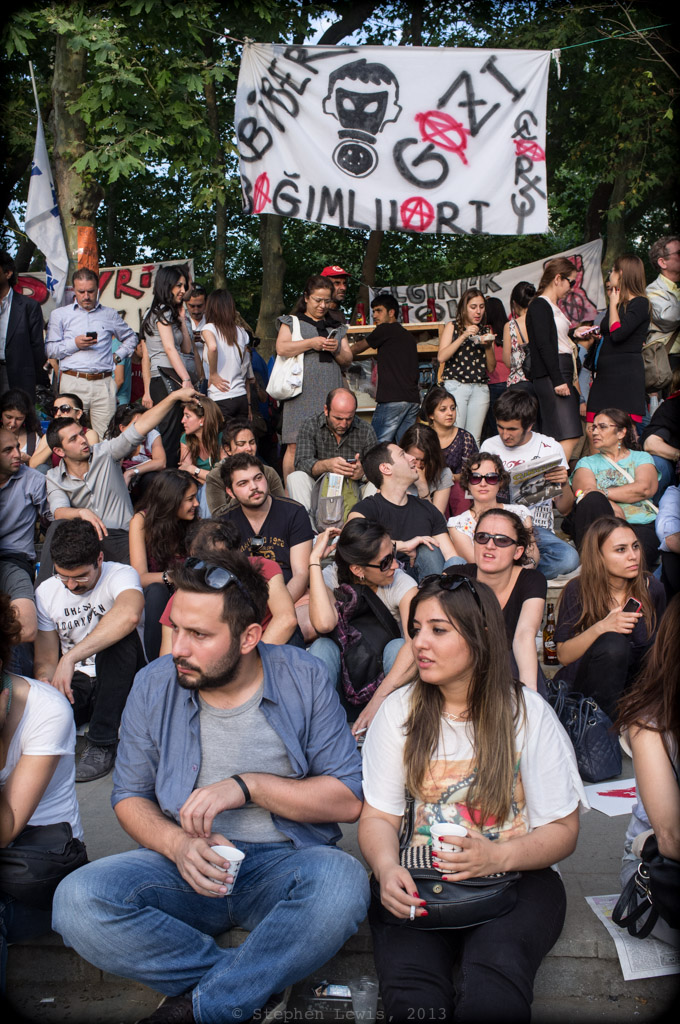
The banner below is headed “Addicted to Pepper Gas/Gezi.”  The anarchist sign in place of the  “e” and the addition of the letter “I” puns “Gas” with “Gezi.”  Gezi Park was cleared of occupiers last Saturday night at 9:00pm by police indiscriminately firing round after round of tear gas into  crowds of peaceful occupiers and visitors, children and elderly included.  I watch scores of victims, some unconscious and some badly burned, being hand carried to a nearby hospital or conveyed by shuttling ambulances. An “addiction” overdose indeed!

Banner text: Pepper Gas/Gezi. Gezi Park Occupation, Istanbul, early-June 2013. (Fuji X100) (For larger image, click on photo.)

Banner heading: ‘”Addicted to Pepper Gas/Gezi.” Gezi Park Occupation, Istanbul, early-June 2013. (Fuji X100) (For larger image, click on photo.)

_DSF2909

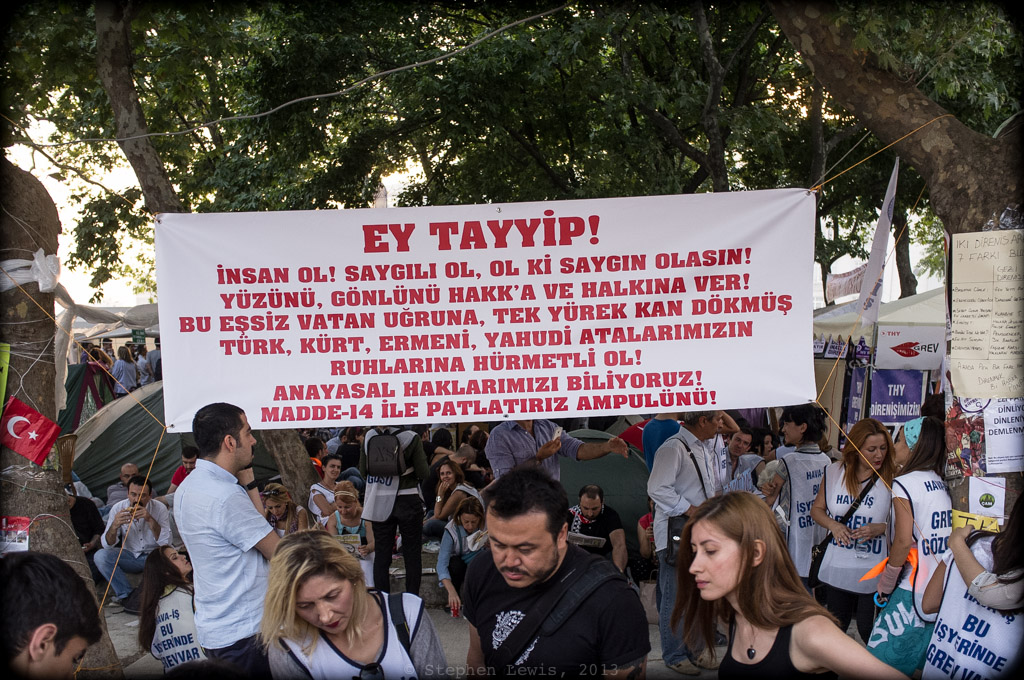
The text of the banner:

Hey, Tayyip!
Be human, show respect and be respected,
Turn your face and heart to God and your people,
Show respect to the souls of our ancestors: Turks, Kurds, Armenians, and Jews,
With a single heart they gave their blood for our unmatched homeland.
We know our constitutional rights.
Together, using Article14 of the constitution,
We will burn out your light bulb (the logo of the ruling AK Party).

(tr. Serhat Güven)

This banner moved me, and not only because I am active in one of the communities it mentions.  As a native New Yorker and the product of an immigrant world, I know the culture of inter-communal respect, public participation, and inclusive politics that commitment to diversity can engender.  And, as someone who, over the years, has also lived and worked in self-proclaimed mono-ethnic, mono-linguistic, and mono-religious countries that, even up to the final years of the 20th-century, marginalized, expelled, and murdered Gypsies, Muslims, and Jews, I know that acknowledgement of the legitimacy of diversity can comprise a giant step towards enduring democracy.  I do not know which group raised this banner and wrote its appeal to Turkey’s “Leader,”  but, whoever they are,  I do thank them respectfully.

The Çarşı encampment, Gezi Park, taken during the first days of the occupation. (FujiX100)

The Çarşı encampment, Gezi Park, taken during the first days of the occupation. (FujiX100) Click on photo for larger image.

Two ubiquitous presences at Occupy Gezi and attendant demonstrations: Çarşı and smart phone cameras.

Çarşı is the fan club of the Beşiktaş football (soccer) club — rough-and-ready, anarchistic, high-spirited, and energetic. Çarşı lent confidence, safety, and a tough urban edge to the protests.  (For more on Çarşı, go the archives of The New Yorker magazine for an excellent profile by writer Elif Batuman).

The age of the smart phone has changed the postures of demonstrators.  Many protesters march with hands held high, by no means in fascist salutes, but holding cell phones to photograph and record seemingly everything in their fields of vision. Every step, every moment of two weeks of protest seem to have been documented and ready for  crowd-sourcing. And, is not impossible that the faces of many activists and protestors have been recorded as well; I  noticed occasional cell phone shutterbugs who, if I were the suspicious type, I would identify as police photographers.  In all, over the weeks, so many people took so many photographs that any privacy disappeared; during the last days of the park occupation, many occupiers posted signs requesting that passersby refrain from photographing them.

iPhone as surrogate telephoto lens. In focus on the iPhone screen and out of focus in the background: "guerilla theater" performed by a troupe of striking Turkish Airlines workers, Gezi Park, first week of occupation. (FujiX100)

iPhone as surrogate telephoto lens. In focus on the iPhone screen and out of focus in the background: “guerilla theater” performed by a troupe of striking Turkish Airlines workers, Gezi Park, first week of occupation. (FujiX100.)  Click on photo for larger image.

Occupiers, Gezi Square, Istanbul, two weeks ago. Çapulcu = Terrorist/Freebooter, a phrase used by the Turkish Prime Minister to describe the occupiers and adopted by the occupiers themselves toungue-in-cheek. (FujiX100)

Occupiers, Gezi Square, Istanbul, two weeks ago. The word “Çapulcu” on the carton “Hotel” sign above = Terrorist/Freebooter, a phrase used by the Turkish Prime Minister to describe the occupiers and adopted by the occupiers themselves tongue-in-cheek. (FujiX100)

The Turkish Prime Minister had described the (now ex-)occupiers of Gezi Square as Looters/Freebooters, subverters of democracy engaged in immoral activities.  Many western newspapers, including the Wall Street Journal as late as this morning’s edition, described them as violent. Do they look the part?

Occupiers, Gezi Square, Istanbul, two weeks ago. If you are tempted to write them off as "mere" student protestors, keep in mind that their parents and a good part of the society supported them to the hilt. (FujiX100)

Occupiers, Gezi Square, Istanbul, two weeks ago. If you are tempted to write them off as “mere” student protestors, keep in mind that their parents, peers, and a good part of the society supported them to the hilt. (FujiX100)

Marchers carrying the banner of a folkloric dance association, Istiklal Cadessi (Avenue), Istanbul, , 1 June 2013,  The hundreds of thousands of other marchers that passed through Istiklal that day ranged from trade unionists to nationalists, to fringe leftists, to lesbians and gays, and to just ordinary people. Marching phalanxes from Istanbul's football (soccer) fan clubs added a tough working-class edge. (Fuji X100)

Marchers carrying the banner of a folkloric dance association, Istiklal Cadessi (Avenue), Istanbul, , 1 June 2013, The hundreds of thousands of other marchers that passed through Istiklal that day ranged from trade unionists to nationalists, to fringe leftists, to lesbians and gays, and to just ordinary people. Marching phalanxes from Istanbul’s football (soccer) fan clubs added a tough working-class edge. (Fuji X100)

As of yesterday morning, I had planned to write a reflective post on the significance and of the confluence of urban issues that sparked the present protests in Istanbul.   I abandoned this idea at 9:00pm last night, when Turkey’s self-styled “Leader” — in a manner redolent of European diplomacy Anno 1938 — unilaterally broke the agreement he had reached on Friday with an umbrella organization of protestors and let the police loose on the occupation encampment in Istanbul’s Gezi Park, at the time packed with a Saturday night crowd of visitors and well-wishers.

A police riot ensued.  I watched scores of protestors and bystanders overcome and burned by tear gas being hand-carried by their fellows to a nearby hospital.  In a side street, I stood with the front-line of peaceful, albeit very vocal, demonstrators as the police, without provocation, sprayed them with jets of chemically tainted water and fired tear gas into their midst as they retreated.  Last week, an acquaintance told me that when the police come to clear the Gezi he and his friends would stop them with “smiles and hugs.”  Sadly, neither worked well against police batons and chemical weapons.

So, instead of focusing on  urban issues, the next several posts to this site will comprise a photographic tribute to the millions of Turkish citizens who peacefully demonstrated and occupied parks and streets these past weeks.  Despite stereotypes presented in the Turkish and Western press, these were demonstrations and not “riots” (the only rioters I saw were the police themselves).  Also, not all demonstrators were young or naive and not all were from the left or the privileged middle class.  And, not all protestors demonstrated or camped in Gezi Park; some simply took to their balconies in residential neighborhoods across the city, banged together pots and pans and shouted: “Tencere, Tava, Tayyip Istifa” (Pot, Pan, Tayyip resign.)

A word on the approach behind the photos in this and the next subsequent entries:

Photojournalists tend to work with extreme telephoto lenses to capture dramatic and “decisive” moments and isolate iconic images.  I photograph mostly up close-up and with moderate wide angle lenses.  I look for context and for ordinary, prosaic moments.  Thus, the photographs that follow attempt to portray the ordered and optimistic nature (to date!) of the present protests and show the diversity of ordinary citizens unjustly accused of looting and rioting.

The Turkish Prime Minister announced that he would never kneel before "looters/freebooters" occupying Gezi Park and the marchers demonstrating on their behalf.  This marching folklorist carries a sign liberally translated as: "Even when we dance Zeybek (a traditional dance involving crouching steps), we do not kneel!"

The Turkish Prime Minister announced that he would never kneel before “looters/freebooters” occupying Gezi Park and the marchers demonstrating on their behalf. This marching folklorist carries a sign liberally translated as: “Even when we dance Zeybek (a traditional dance involving crouching steps), we do not kneel!.” It remains to be seen who, in the end, will be the one(s) kneeling. (FujiX100)