Archive

Urban Dynamics

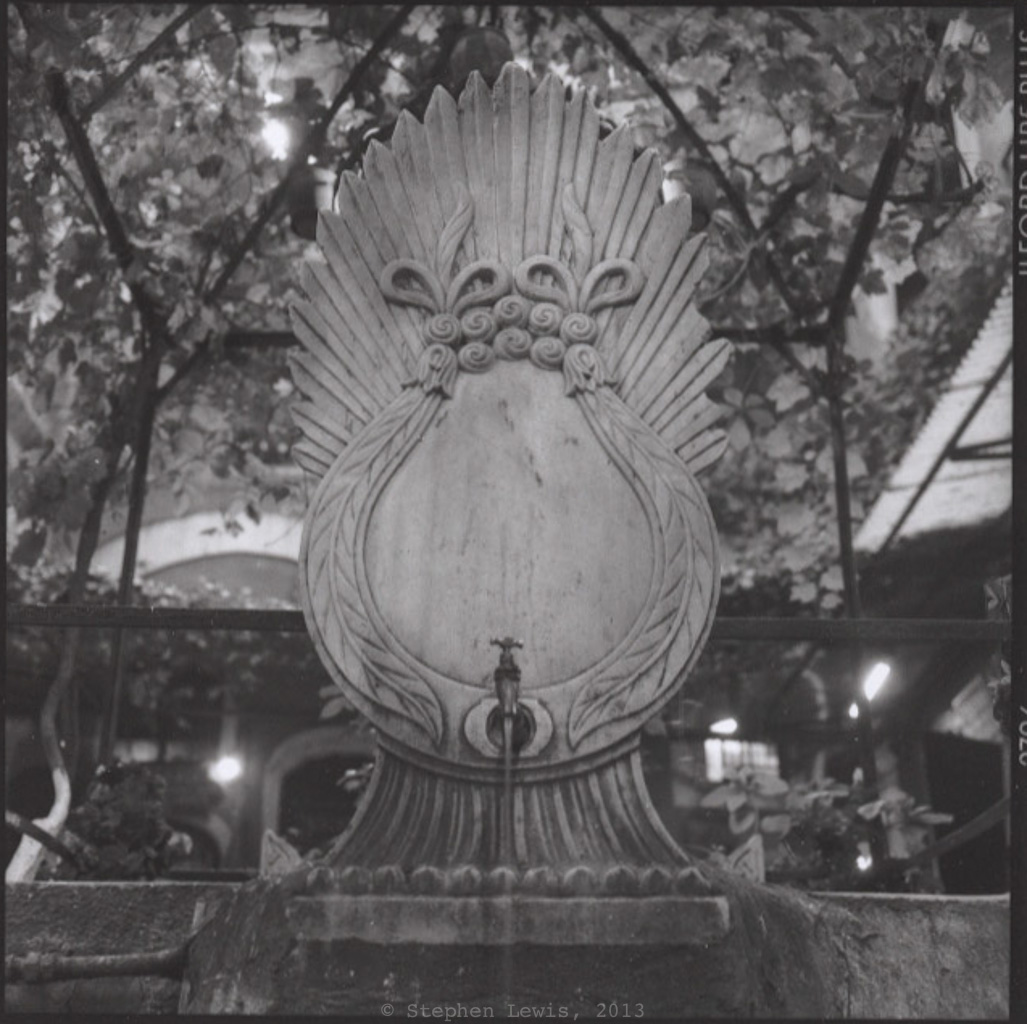
Derelict fountain, Galata, Istanbul, ca. 2000. (Rolleiflex Xenotar f2.8, Ilford HP5, scan of print.)  Click to enlarge.

Derelict fountain, Galata, Istanbul, ca. 2000. (Rolleiflex Xenotar f2.8, Ilford HP5, scan of print.) Click to enlarge.

Further to my previous post on water, fountains, et. al.

Processes of decline and abandonment

Two decades ago, I began to photograph the historic water fountains (çeșme) and water kiosks (sebil) of Istanbul.  I began, not with the grand and monumental, but with obscure and abandoned — those in backstreets, alleyways, and courtyards, functioning and non-functioning fragments of legacy urban infrastructure, overlooked by scholars,  their features surrendered to the elements, decay, and neglect. The forgotten origins and gradual disappearance of many of these structures seemed symbolic of larger urban processes of decline and abandonment — processes that are as central to the functioning and continuity of cities as are restoration and (re)development.

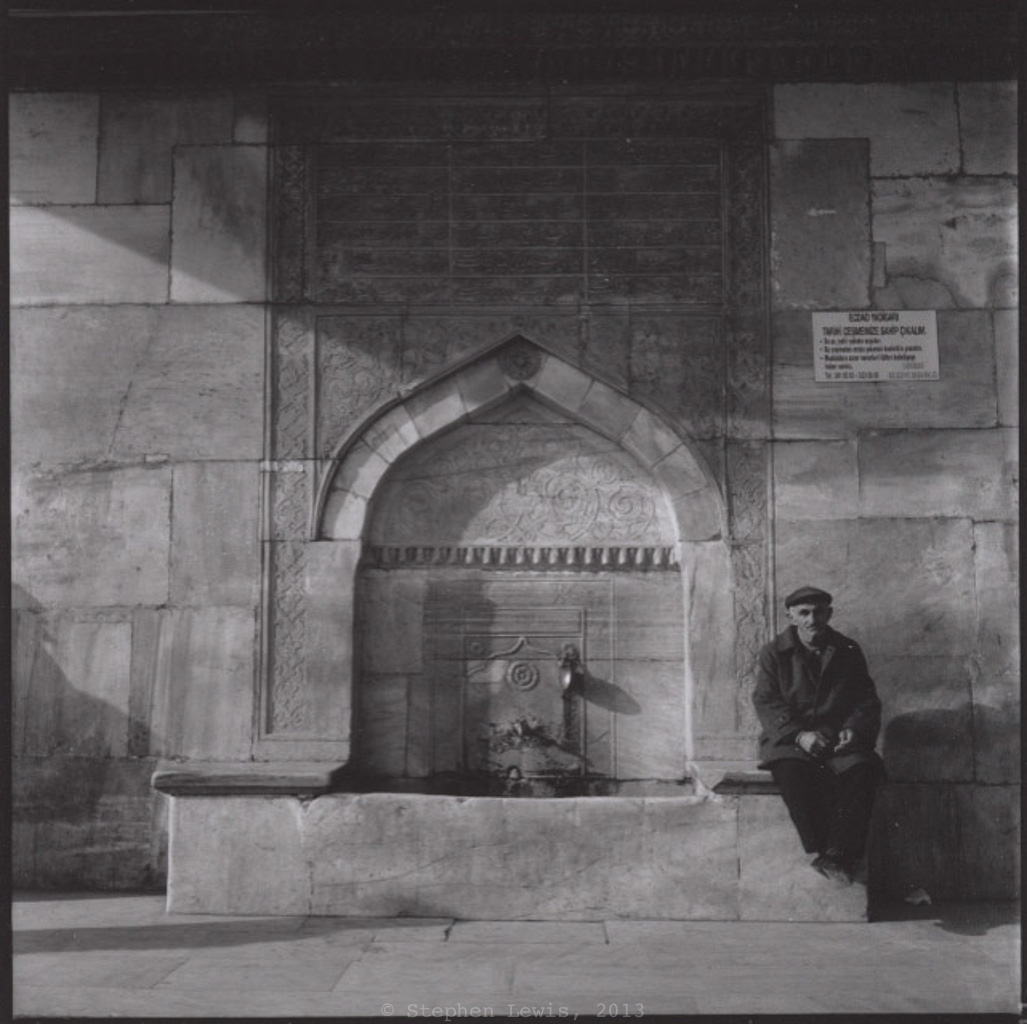
Fountain, seemingly from late-18th-century spolia, Zincirli Han, Kapalı Çarşıı, Istanbul, ca. 2000. (Rolleiflex Xenotar 2.8, Ilford XP2, scan of print.) Click to enlarge.

Fountain, seemingly from late-18th-century spolia, Zincirli Han, Kapalı Çarşı, Istanbul, ca. 2000. (Rolleiflex Xenotar 2.8, Ilford XP2, scan of print.) Click to enlarge.

Aesthetic rather than documentary

At the time, my approach to fountains and kiosks aesthetic rather than documentary.  My eye was drawn to single planes as much as to entire structures, to textures as much as to decorative elements, to materials and much as to settings, and to the marks of time as much as to original appearances.  The joy of finding in the focusing screens of my Rolleiflexes the tensions and calming balances inherent to subject matter was paramount.

Frontal detail of the early-eighteenth-century Iskele (quayside) fountain, Uskudar, Istanbul, 1997. (Rolleiflex Tessar f3.5, Ilford HP5, scan of print). Click to enlarge.

Frontal detail of the early-eighteenth-century Iskele (quayside) fountain, Uskudar, Istanbul, 1997. (Rolleiflex Tessar f3.5, Ilford HP5, scan of print). Click to enlarge.

Marchers approaching Gezi Park from Osman Bey and Harbiye; Istanbul, early-June, 2013. In the center, the uncompleted open trench for an automobile underpass under and through Taksim Square, the main element in the road widening project that initially sparked the Gezi Park occupation. (Fuji X100). Click on image to enlarge.

Marchers approaching Gezi Park from Osman Bey and Harbiye; Istanbul, early-June, 2013. In the center, the uncompleted open trench for an automobile underpass under and through Taksim Square, the main element in the road widening project that initially sparked the Gezi Park occupation. (Fuji X100). Click on image to enlarge.

During the Gezi Park occupation, marchers from the direction of Harbiye and the residential neighborhoods beyond it appeared to be more diverse in age and in walks-of-life than those marching from the night-spot-filled side-streets and central promenade of Istiklal Caddesi.  This past Sunday, such diversity was augmented by the large turnout for a lesbian and gay march to Taksim and Gezi Park.

A Road to Nowhere?

By itself, the Turkish government’s plan to shunt traffic under and past Taksim Square might indeed lessen vehicular congestion, thus freeing this iconic location from dominance by motor vehicle traffic.  In conjunction with the plan to replace all of Taksim Square and Gezi Park with a massive complex of shopping mall, mosque, and fantasy reconstruction of a 19th-century military barracks, however, the underpass will instead deliver more automobile traffic into the urban core, a further step toward transforming a vital, unplanned, dense, “legacy” urban agglomeration into just another suburb.

There Is No There There”

Had the early-twentieth-century American expatriate writer and aesthete Gertrude Stein still been alive, and had she visited Istanbul this month and last, she no doubt would have joined the protests at Taksim and Gezi Park and almost certainly would have attended the recent lesbian and gay march.

Nearly a century ago, describing the seemingly charming town of Sausaliito, north of San Francisco, Stein is said to have quipped: “There is no there there.”  In Istanbul, by giving primacy to the automobile and the development of giant office and residential towers and suburban-type mall complexes, the powers-that-be are compromising pedestrian flows and traditional street life, thus contributing to a future in which, without doubt, there will be almost “… no there there.”

“Seventy-Two Suburbs in Search of a City”

American writer and humorist Dorothy Parker, a contemporary of Stein, once described the megalopolis Los Angeles as “… seventy-two suburbs in search of a city.”  The present near-dysfunctional state of greater Los Angeles provides a cautionary tale for Istanbul as it continues its far-flung expansion and  conversion into a near endless checkerboard of malls, office parks, and gated residential “communities” all interconnected by automobile traffic.

Read More

Köfteci. A street vendor of grilled köfte sandwiches, Gezi Park, early-June 2012. (Fuji X100). (Click on photo to enlarge.)

Köfteci. A street vendor preparing and selling  grilled köfte sandwiches, Gezi Park, early-June 2012. (Fuji X100). (Click on photo to enlarge.)

During the weeks it was extant, the Gezi Park encampment was organized and disciplined.  A committee of participating organizations put political differences far enough aside to ensure provision of essential services — sanitary, medical, and emergency.  Volunteers cooked and served in cafeteria-style kitchens well stocked with donated provisions.
Street Vendors
In addition to the means served to those encamped in the Gazi Park, the dense concentration of protestors, well-wishers, and the curious  attracted scores of ordinary street vendors.  Many such vendors were of types traditional to the streets of Istanbul — sellers of köfte, of  rice topped with shredded chicken, of hot boiled corn, and of circular bread rolls dusted with toasted sesame seeds (semit); others represented fast responses to the one-off needs of protesters.  The latter hawked Turkish flags and portraits of Atatürk, t-shirts emblazoned with slogans of protest, and simple painter’s masks and cheap swimming goggles, both passed off as protection against tear gas.  Beverage vendors did brisk businesses selling ice-cold bottled water and — rarely seen on the streets of Istanbul — beer.  Indeed, in the initial days of the occupation and demonstrations, polishing off a bottle of beer, as well as providing refreshment, was a principled statement of opposition to a regime intent furthering a sectarian-driven war to limit alcohol consumption. In the end, Gezi Park occupiers eventually banned beer vendors, this to disprove  the Turkish Prime Minister’s allegations of nightly drunkenness and debauchery in the protestors’ encampment.  According to one report, at least one beer vendor put up violent resistance to such expulsion, stabbing a protester in the process.)

Revolutionary melon slices for a revolutionary market. The slogan scratched onto the watermelon: "Taksim, the people's revolution is coming." But, no matter how progressive, red, and tasty such melon slices may have been, the going price -- five lira per serving -- was counter-revolutionary at best! (Fuji X100) (Click on image to enlarge).

Revolutionary melon slices for a revolutionary market. The slogan scratched onto the watermelon: “Taksim, the people’s revolution is on.” But, no matter how red and tasty such melon slices may have been, the going price — five lira per serving — was counter-revolutionary at best! (Fuji X100) (Click on image to enlarge).

Read More
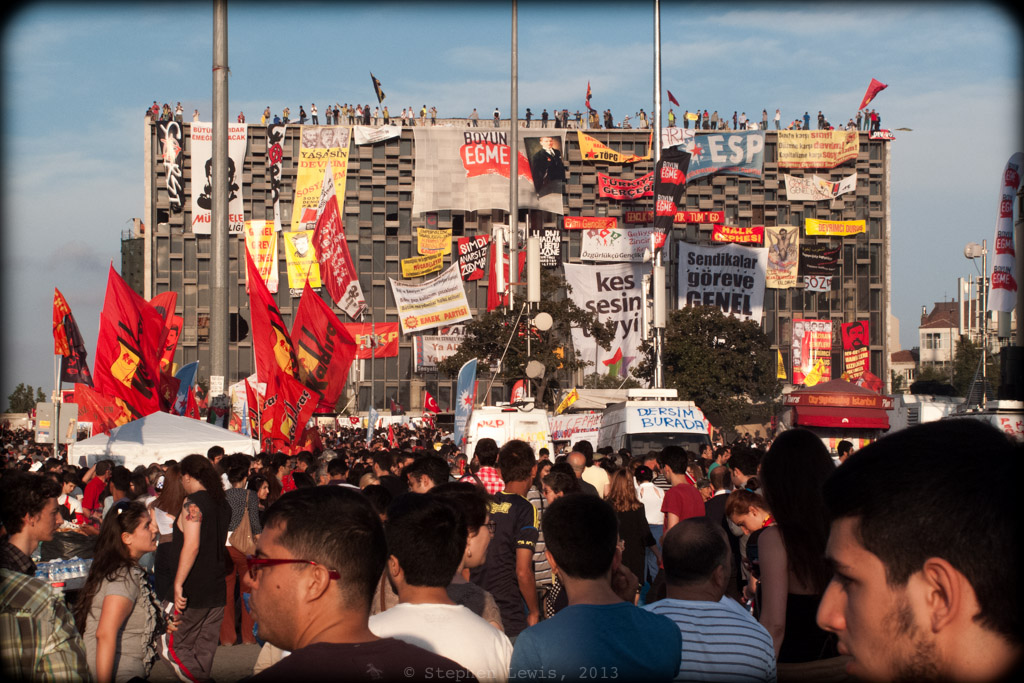
Atatürk Cultural Center, Taksim Square, Istanbul, occupied and bedecked with banners of left wing groups, early-June 2013. (Canon G10) (Click on photo for larger image.)

Atatürk Cultural Center, Taksim Square, Istanbul,  bedecked with banners of left wing groups, Gezi Park occupation, early-June 2013. (Canon G10) (Click on photo to enlarge image.)

This past Saturday night, police once again ran amok in Taksim Square, Istanbul, using tear gas and high-pressure streams of chemically tainted water to drive away protesters.  The attack was minor, however, in comparison with the police’s violent ejection of occupiers and visitors to Gezi Park the Saturday before and their night-long violent siege of Taksim five days earlier.

A Change of Banners

During the two-week-long occupation of Gezi Park, adjacent Taksim Square was a locus of protest for left-wing demonstrators, many of them representatives of fragmented parties driven   ideologies more than  constituencies. As part of the Gezi occupation, a group of protesters took over the long-abandoned Atatürk Cultural Center building, a 1960s structure fronting on Taksim.  The steel-lattice-covered facade of the Atatürk Center made a perfect multistory bulletin-board for the banners of revolutionary sub-sects.  The first act of the Police upon clearing the Center of occupiers was to remove their banners and replace them with a triptych of a giant prim portrait of Atatürk flanked by two equally immense Turkish flags.  This ensemble conspicuously lacked the immense portrait of Turkey’s Prime Minister that is usually hung alongside that of Atatürk at the his outdoor rallies and as a backdrop to his lengthy television addresses).
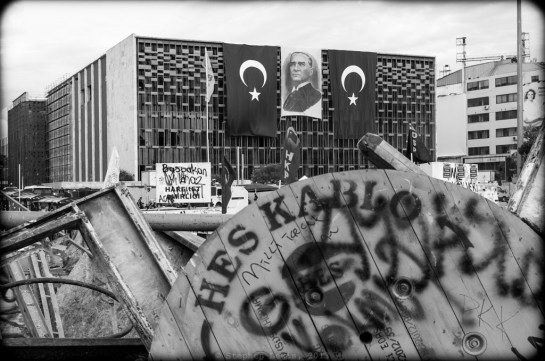
 

Atatürk Curlutral Center, the morning after a brutal siege by police a week and a half ago.  Immediately after the siege, the police removed banners hung by left-wing groups and replaced them with a portrait of Atatürk flanked by two Turkish flags.  In an uncharacteristic departure from the usual iconography of of the present regime, a portrait of Prime Minister Erdoğan is conspicuous in its absence. (Fuji X100).  (To magnify image, click on photo)

Atatürk Cultural Center, the morning after a brutal siege by police a week and a half ago. Immediately after the siege, the police removed banners hung by left-wing groups and replaced them with a portrait of Atatürk flanked by two Turkish flags. In an uncharacteristic departure from the usual iconography of of the present regime, a portrait of Prime Minister Erdoğan is conspicuous by its absence. (Fuji X100). (To magnify image, click on photo)

Issues Crystallize Discontents

The occupation, demonstrations,  vigils, and battles around Gezi Park and Taksim Square this month provided a political and physical rallying point for overall discontent with the authoritarianism and sectarianism of the Erdogan regime and with its aggressive contempt for that half of the Turkish polity who do not support it.  Underlying this broader discontent were several sets of concrete issues that kicked-off the protests in the first place, including the relationship of policy-makers and profit-makers in the urban sphere, and the nature, ownership, and future of the urban landscape (more on this in a subsequent post).

Iconography of Urban Space

A subset of these issues involves the iconography of urban space and urban constructs.  For decades, Taksim has been destination and site for political marches, celebrations, and (all too often violently repressed) protests. Taksim, thus is  a  symbol of both the political cohesion and the political and social conflicts of the Turkish Republic.  The present plans of the Erdogan government to replace this meaning-charged open space with a full-sized replica of a late-Ottoman-Empire military barracks razed a century ago speaks volumes about the political, social, and cultural attitudes and intents of the present government, as does the government’s plan to demolish the Atatürk Center, once venue for concerts, opera, and theater, and named after the founder of the modern, secular Turkish Republic.  The reconstructed barracks, by the way, is slated to be one element of of a giant shopping-center and mosque complex planned to obliterate the footprint of what are now Gezi Park, Taksim Square, and the Atatürk Center.

Read More