Archive

Turkey

Minaret surrounded by nondescript concrete structures, Kasım Paşa, Istanbul, 2012. (Fuji X100) Click to enlarge.

Minaret surrounded by nondescript concrete structures, Kasım Paşa, Istanbul, 2012. (Fuji X100) Click to enlarge.

The minaret of a small mosque is hidden amidst a forest of unadorned concrete structures built with minimal investments and maximum yields in mind, probably during the 1960s or 70s.  Many such buildings only barely pass present-day vetting for earthquake resilience.  The tall structure in the center probably owes its improbable form to being built on the plot of a razed characteristically-narrow 19th-century low-rise structure.  The ensemble created by these unattractive buildings, however, has an undeniable, albeit harsh, beauty of its own.

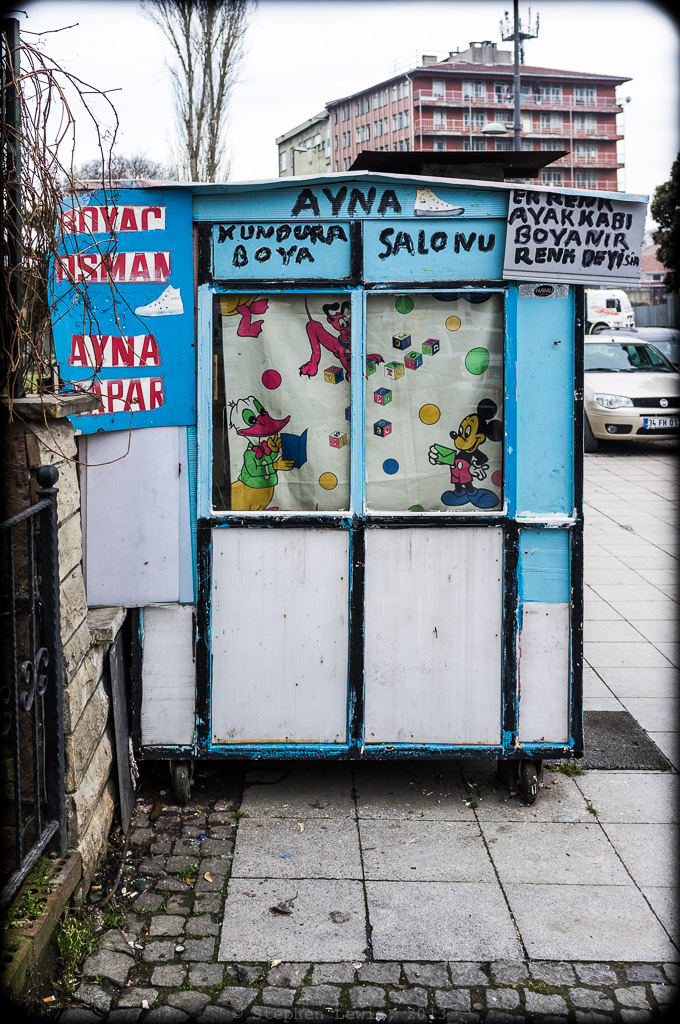
Shine Osman's "Looking Glass Shine" shoeshine stand, Kasım Paşa, Istanbul, 2013. Note the minimal footprint, functional design, recycled materials, and curious Donald Duck, Goofy, and Mickey Mouse themed curtains. (Fuji X100) Click to enlarge.

“Shine” Osman’s “Looking Glass Shine” shoeshine stand, Kasım Paşa, Istanbul, 2013. Note the modest footprint, functional design, recycled materials, and curious Donald Duck, Goofy, and Mickey Mouse themed curtains. (Fuji X100) Click to enlarge.

The ideal real estate “development”project: A sidewalk shoeshine stand on one the main streets of Kasım Paşa, the mostly religious, mostly working class quarter of Istanbul that numbers amongst its better known sons Turkey’s present prime minister, Recıp Tayip Erdoğan.  The structure comprises a minimal intrusion into public space.  Its form is dictated by its function and by the materials at hand.  The business itself is geared to the needs and flows of the pedestrians traffic that passes it.  The Romany origins of the proprietor point to a wealth of lessons about urban sustainability that remain to be learned from the past and present roles of urban Roma.  More on this in a future post …

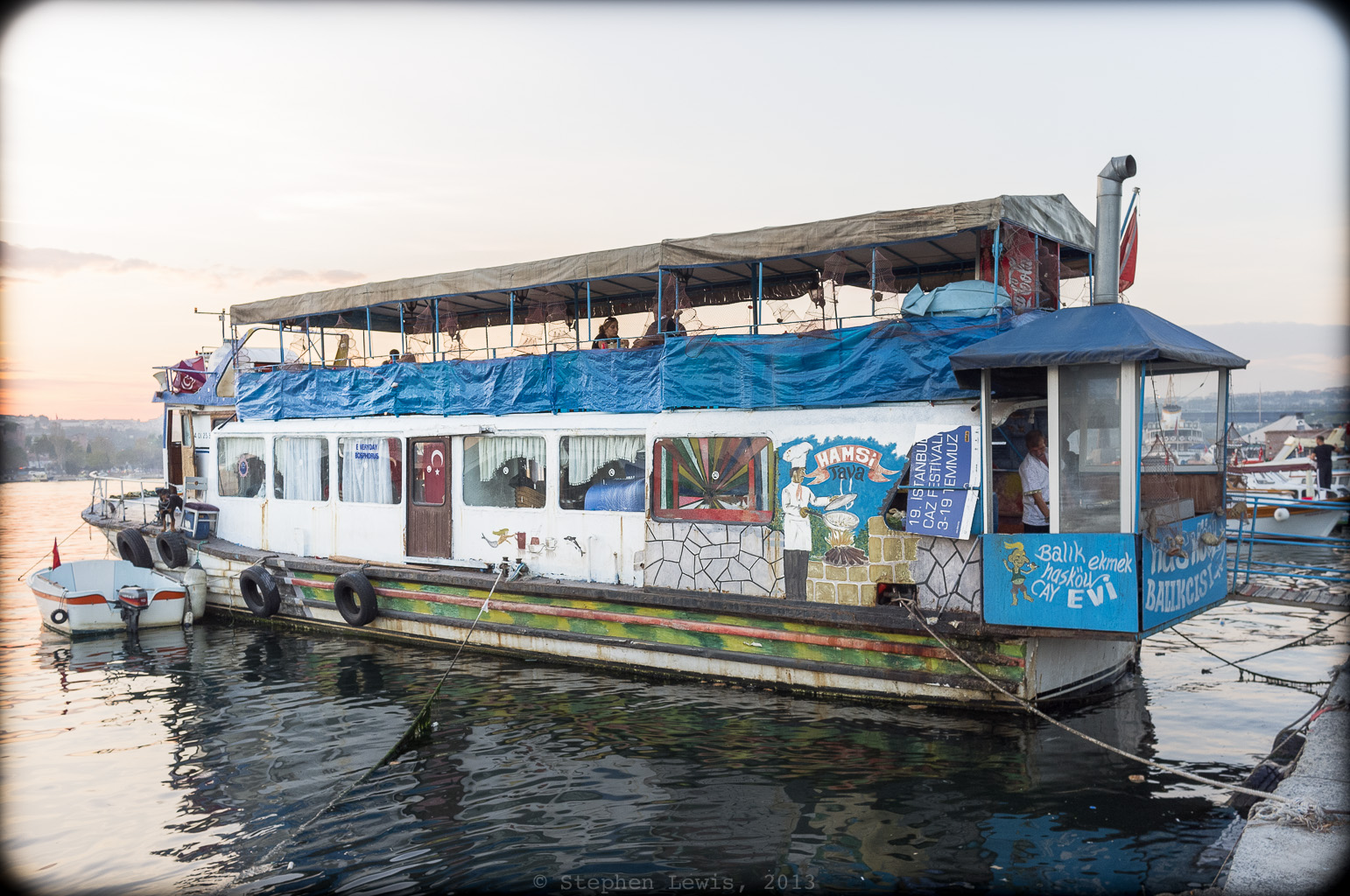
An anchored boat converted to a fish sandwich and fried anchovy restaurant, Golden Horn, Hasköy, Istanbul, 2013.  Note the kitchen topped with jaunty chimney  perched precariously in the after-fitted poop-deck. (Fuji X100)  Click to enlarge.

An one-time small urban ferry converted to a fish sandwich and fried anchovy (hamsi) restaurant, moored on the shore of the Golden Horn, Hasköy, Istanbul, 2013. Note the kitchen and its jaunty chimney perched precariously in an after-fitted poop-deck. (Fuji X100) Click to enlarge.

Further to a previous post on Gezi Park, Istanbul street vendors, etc.

One of the concepts that has stuck with me from my long-ago graduate training is in the form of a concisely worded dictum that continues to prove its veracity over and again in scores of cities worldwide.  I’ve forgotten the precise wording and source, but the  paraphrase that follows is faithful to original: “The economy of a city is dependent on a continuous supply of declining housing stock.”

Hirschman

The concept, it turns out, comes from the works of economist Albert 0. Hirschman.  There has been a recent revival of interests in Hirschman’s life, professional accomplishments, and thought.  The publication earlier this year of a biography of Hirschman brought in its wake articles and reviews in the New York Review of Books, the New Yorker, and the New York Times.  The course of Hirschman’s life — childhood in Berlin, anti-Nazi activist, volunteer in the Spanish Civil War, smuggler of Jewish refugees out of Vichy France, victim of the McCarthy era in the US, specialist in international development, resident scholar at Princeton — is as fascinating as his economics, the latter a non-ideological pragmatism, literary rather than econometric in method, that side-steps master plans to find opportunities in seeming negativities and value in seeming dysfunctions.

The Power of Decline

Declining housing (and commercial) stock provides shelter for those on the way up and those on the way down.  It enables the solvency of those who do heavy-lifting and work at the edges of economies, those very people without whom neither industrial not service economies can function.  It provides affordable locales for cultural renewal and technological innovation.  It provides space for new sectors and enables older sectors — and the employment they provide and skills they preserve — to survive.  It contributes to the social interaction and proximity to others who are different than one’s self that is central to democracy. For generations, the agglomerations of flexible, high value-added, small enterprises that grew around the entrepot functions of cities such as New York had been dependent on re-purposed inexpensive physical plant.

Afterthoughts: From Istanbul to Harlem

  • Apropos of the recent protests in Istanbul, as treated in a number of past posts below, opportunities for incremental reuse contribute far more to social and political cohesion than do the seizing of public space and the razing of viable structures and neighborhoods to make way for massive development projects driven by political cronyism and the financial self-interests of investors and design-driven megalomania of architects.
  • As we see from the photo above, ample supplies of underutilized urban coastline also contribute to the mix of seeming negatives that Hirschman would encourage looking at afresh — likewise with ample supplies of declining boat stock!
  • Last, for a few words on the negative impact of sudden “upscaling” of a a viable and creative neighborhood many of the strengths of which was rooted in its state of perpetual decline, click here for a piece I wrote some years ago mourning the closing of the old Reliable’s Cafeteria and its upscale sister, Copeland’s Restaurant, on West 145th St. in New York City’s Harlem.
Anchors, Cables, Ropes. Perșembe Pazarı, Galata, Istanbul, 2011.  The waterfront site of Perșembe Pazarı (The Thursday Market) has housed the workplaces of ships' chandlers for more than a millennium.  (Toyo field camera, Rodenstock135mm f5.6, medium format color negative in 6x9cm back). Click to enlarge

Anchors, Cables, and Ropes. Perșembe Pazarı, Galata, Istanbul, 2011. The waterfront site of Perșembe Pazarı (The Thursday Market) has housed the workplaces of ships’ chandlers and hardware makers for more than a millennium. (Tripod-mounted Toyo field camera, Rodenstock135mm f5.6, 6x9cm roll film back, drum scan of color negative). Click to enlarge

Some “meta-reporting” further to my recent post entitled Istanbul Conflicts From Afar: Issues and Aspersions, Headscarves and Rambo

Kudos and “Great Expectorations”

Over the past two weeks Istanbul Conflicts From Afar received some attention and even kudos.  On July 10, WordPress (the hosts of Bubkes.Org) featured the post in their “Freshly Pressed” listing of read-worthy blog activity.  On July 20, Doc Searls of the Berkman Center for Internet and Society at the law school of Harvard University included it in a string of quotes summarizing a selection of my postings to date.  More important, Doc  tracked down the US Public Radio broadcast (“Great Expectorations”) that revealed the suspect origins of the malicious and overused “spat upon Vietnam vet” urban legend.  To read the full transcript of the the broadcast click here.

Linux Journal and Working Class New York

By coincidence, only a few days before Doc posted his review of Bubkes.Org, I received an email from the urban, water, and infrastructure expert mentioned in my post Istanbul: Water, Fountains, Taksim, and Infrastructural Tourism.  In his email, the expert included this link to another mention of me by Searls in a 2008 piece for Linux journal.  In the 2008 article, Doc referred to a posting to my old weblog Hakpaksak in which I quoted from Joshua Freeman’s excellent book Working Class New York on the appeal of what remains of the unique character, ethos, and capabilities of New York City as it was prior to the rise and fall of the financial sector.  The collision of the New York of heavy lifting and manual skills with the New York of trading floors and computer screens remains for me a subject of ongoing observation that colors my portrayals, written and photographic, of cities my native New York, Istanbul, and my very own private bench-scale urban laboratory of sorts: Sofia, Bulgaria.

Scrap dealers' handcarts parked and at rest, Tepebaşı, Beyoğlu, Istanbul, 2012.  (Fuji X100) Click to enlarge

Scrap dealers’ handcarts parked and at rest, Tepebaşı, Beyoğlu, Istanbul, 2012. (Fuji X100) Click to enlarge

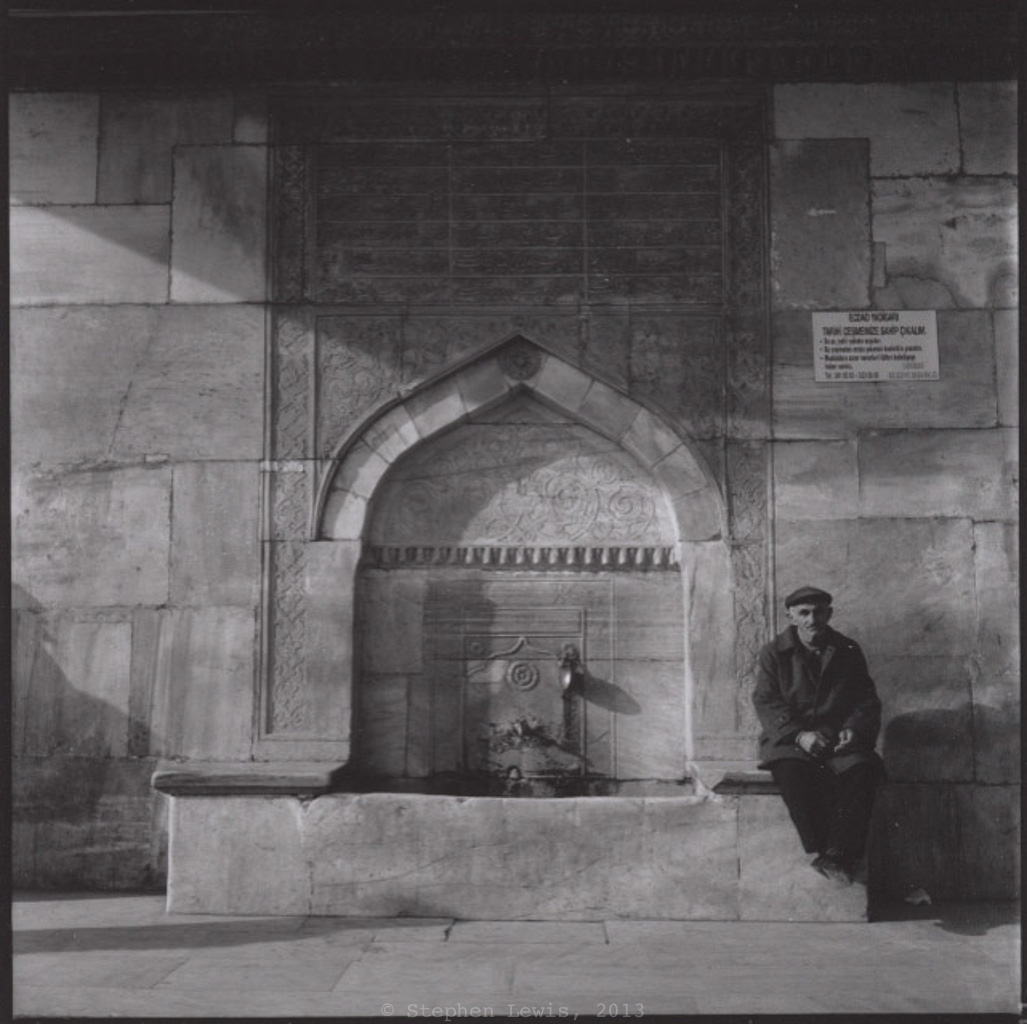
Derelict fountain, Galata, Istanbul, ca. 2000. (Rolleiflex Xenotar f2.8, Ilford HP5, scan of print.)  Click to enlarge.

Derelict fountain, Galata, Istanbul, ca. 2000. (Rolleiflex Xenotar f2.8, Ilford HP5, scan of print.) Click to enlarge.

Further to my previous post on water, fountains, et. al.

Processes of decline and abandonment

Two decades ago, I began to photograph the historic water fountains (çeșme) and water kiosks (sebil) of Istanbul.  I began, not with the grand and monumental, but with obscure and abandoned — those in backstreets, alleyways, and courtyards, functioning and non-functioning fragments of legacy urban infrastructure, overlooked by scholars,  their features surrendered to the elements, decay, and neglect. The forgotten origins and gradual disappearance of many of these structures seemed symbolic of larger urban processes of decline and abandonment — processes that are as central to the functioning and continuity of cities as are restoration and (re)development.

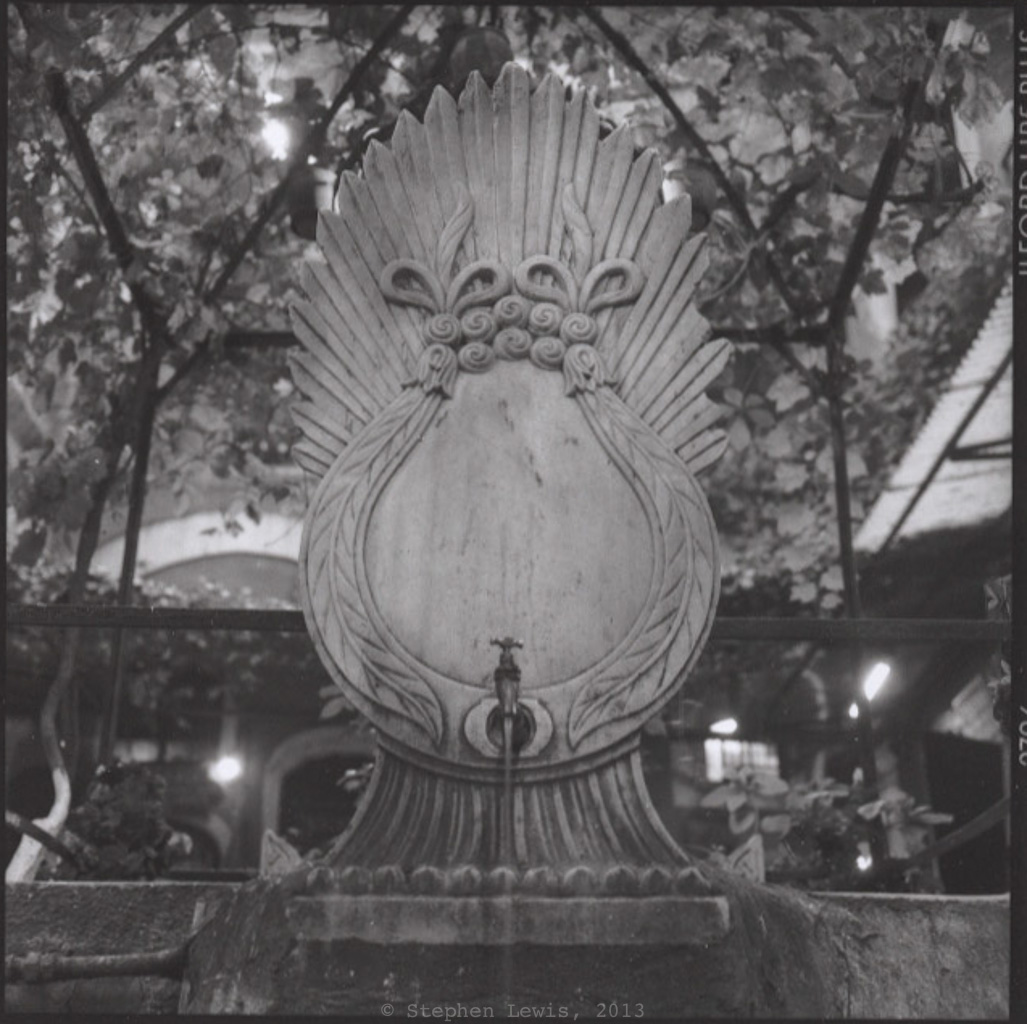
Fountain, seemingly from late-18th-century spolia, Zincirli Han, Kapalı Çarşıı, Istanbul, ca. 2000. (Rolleiflex Xenotar 2.8, Ilford XP2, scan of print.) Click to enlarge.

Fountain, seemingly from late-18th-century spolia, Zincirli Han, Kapalı Çarşı, Istanbul, ca. 2000. (Rolleiflex Xenotar 2.8, Ilford XP2, scan of print.) Click to enlarge.

Aesthetic rather than documentary

At the time, my approach to fountains and kiosks aesthetic rather than documentary.  My eye was drawn to single planes as much as to entire structures, to textures as much as to decorative elements, to materials and much as to settings, and to the marks of time as much as to original appearances.  The joy of finding in the focusing screens of my Rolleiflexes the tensions and calming balances inherent to subject matter was paramount.

Frontal detail of the early-eighteenth-century Iskele (quayside) fountain, Uskudar, Istanbul, 1997. (Rolleiflex Tessar f3.5, Ilford HP5, scan of print). Click to enlarge.

Frontal detail of the early-eighteenth-century Iskele (quayside) fountain, Uskudar, Istanbul, 1997. (Rolleiflex Tessar f3.5, Ilford HP5, scan of print). Click to enlarge.

A vendor of parakeets dwarfed by a late-Ottoman fountain, vicinity of Gedik Paşa Caddesi, Istanbul, 2012. (Fuji X100) Click to enlarge.

A vendor of parakeets dwarfed by a late-Ottoman fountain, vicinity of Gedik Paşa Caddesi, Istanbul, 2012. (Fuji X100) Click to enlarge.

Like some cities, Istanbul arose because of water.  Like all cities, Istanbul is sustained by water.

Istanbul is situated at the juncture of strategic waterways central, since the dawn of history, to world trade.  The narrow channel of the Bosporus divides European from Asian Istanbul and links the Black Sea to the Sea of Marmara  and, beyond it, via the Dardanelles, to the Aegean and Mediterranean.  River channels flowing into these waterway shaped the geography of Istanbul and, for centuries, the placid inlet of the Golden Horn provided the city with the advantage of a sheltered, defensible harbor.

Fountains and Taksim

Istanbul is fed by a water distribution system that has grown incrementally over two millennia.  Until modern times, aqueducts conveyed water from the west and north into city where it was stored in reservoirs and cisterns and delivered to end users via neighborhood fountains endowed by legacies and pious foundations.  Hundreds of such fountains survive until today.  Some are monumental, others pedestrian; some function, others not; some have been grandly restored, others forgotten or subjected to Gerry-built repairs.  (Taksim Square, the site of recent demonstrations , derives its name — literally “branch” — from its past role as a distribution point for water brought by aqueduct from the lakes and forests of the Istanbul’s Black Sea coast).

Infrastructural Tourism

Back in May, I was visited in Istanbul by the family of a former client/colleague, a specialist in the funding and evaluation of infrastructure and infrastructural projects and an expert in the fields of fresh and waste water.  The thrust of our day together was to note the features of the layers of infrastructure — including Ottoman-era fountains — that have served Istanbul over centuries past and during its ten-fold growth in population during the twentieth.  We referred to our itinerary as “infrastructural tourism.”  Alas, we cannot call this phrase our own. Infrastructural tourism appears already to be underway, albeit searching for its own content and method, as per this report at Design Observer.

Gezi Park, early-June, 2013.  A prime minister's unsubstantiated allegations of desecration of mosques, attacks on pious women, and public drinking and sex (both, alas, missed by this observer) recall an ugly, divisive canard of the Vietnam War era. (Fuji X100). (Click on image to enlarge).

Gezi Park, early-June, 2013. A prime minister’s unsubstantiated allegations of desecration of mosques, attacks on pious women, and public drinking and sex (both, alas, missed by this observer) recall a cheap, divisive canard of the Vietnam War era. (Fuji X100). (Click on image to enlarge).

From Sofia, Bulgaria, a final post on last month’s occupation of Gezi Park and the trajectory of protests in Istanbul and throughout Turkey …

As of this past Wednesday, the Turkish government’s plan to for the “development” of Gezi Park and Taksim Square was put on hold.  A Turkish court, responding to a petition by Istanbul’s Chamber of Architects, held the project in violation of architectural preservation laws, this due to the historical character and functions of Gezi/Taksim.

From afar and in retrospect, an underlying difference between the protestors and the prime minister and his supporters springs to the fore.  On the side of the former there has been a focus on concrete issues and coalition-building;  on the side of the latter, however, there has been a ducking of issues and, instead, a retreat into intimidation, aspersions, and ad hominem attack.   A “scorecard” of sorts — and a cautionary tale of headscarves and Rambo — follow …

Read More

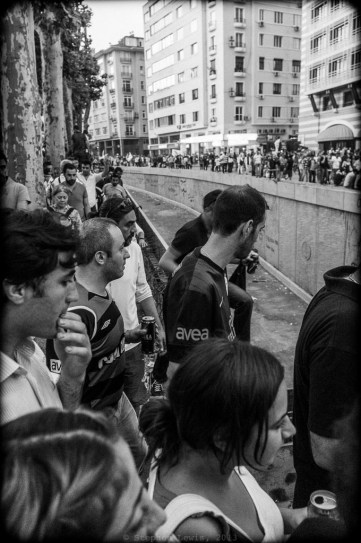
Marchers approaching Gezi Park from Osman Bey and Harbiye; Istanbul, early-June, 2013. In the center, the uncompleted open trench for an automobile underpass under and through Taksim Square, the main element in the road widening project that initially sparked the Gezi Park occupation. (Fuji X100). Click on image to enlarge.

Marchers approaching Gezi Park from Osman Bey and Harbiye; Istanbul, early-June, 2013. In the center, the uncompleted open trench for an automobile underpass under and through Taksim Square, the main element in the road widening project that initially sparked the Gezi Park occupation. (Fuji X100). Click on image to enlarge.

During the Gezi Park occupation, marchers from the direction of Harbiye and the residential neighborhoods beyond it appeared to be more diverse in age and in walks-of-life than those marching from the night-spot-filled side-streets and central promenade of Istiklal Caddesi.  This past Sunday, such diversity was augmented by the large turnout for a lesbian and gay march to Taksim and Gezi Park.

A Road to Nowhere?

By itself, the Turkish government’s plan to shunt traffic under and past Taksim Square might indeed lessen vehicular congestion, thus freeing this iconic location from dominance by motor vehicle traffic.  In conjunction with the plan to replace all of Taksim Square and Gezi Park with a massive complex of shopping mall, mosque, and fantasy reconstruction of a 19th-century military barracks, however, the underpass will instead deliver more automobile traffic into the urban core, a further step toward transforming a vital, unplanned, dense, “legacy” urban agglomeration into just another suburb.

There Is No There There”

Had the early-twentieth-century American expatriate writer and aesthete Gertrude Stein still been alive, and had she visited Istanbul this month and last, she no doubt would have joined the protests at Taksim and Gezi Park and almost certainly would have attended the recent lesbian and gay march.

Nearly a century ago, describing the seemingly charming town of Sausaliito, north of San Francisco, Stein is said to have quipped: “There is no there there.”  In Istanbul, by giving primacy to the automobile and the development of giant office and residential towers and suburban-type mall complexes, the powers-that-be are compromising pedestrian flows and traditional street life, thus contributing to a future in which, without doubt, there will be almost “… no there there.”

“Seventy-Two Suburbs in Search of a City”

American writer and humorist Dorothy Parker, a contemporary of Stein, once described the megalopolis Los Angeles as “… seventy-two suburbs in search of a city.”  The present near-dysfunctional state of greater Los Angeles provides a cautionary tale for Istanbul as it continues its far-flung expansion and  conversion into a near endless checkerboard of malls, office parks, and gated residential “communities” all interconnected by automobile traffic.

Read More

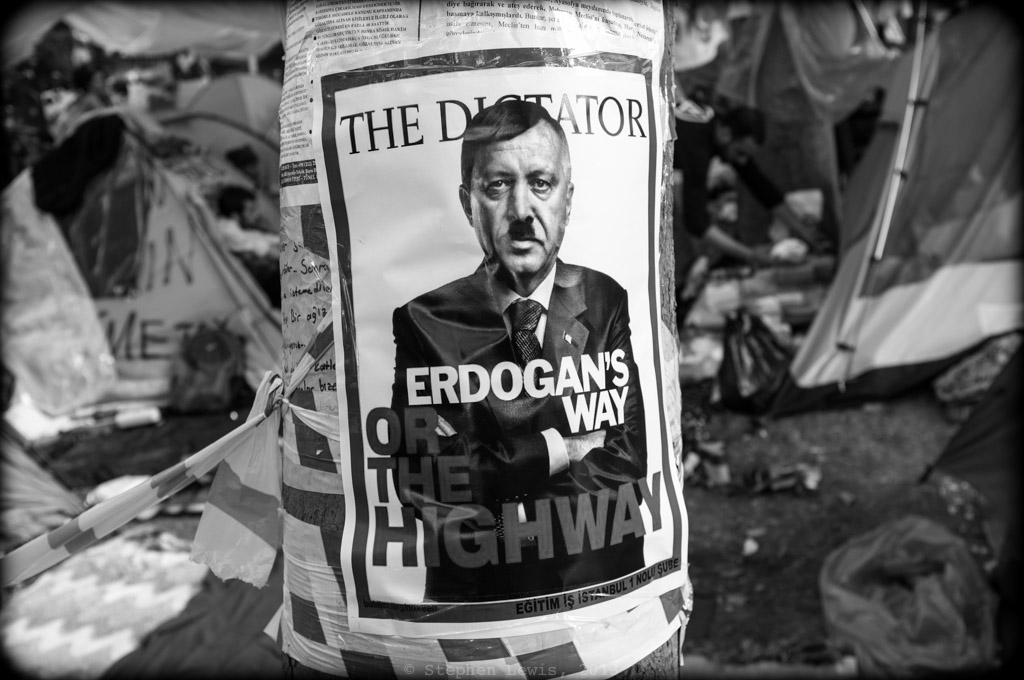
A frequent characterization; Gezi Square, Mid-June, 2013.  To use New York terms of reference, a caricature as a cross between an end-of-career Robert Moses, a Watergate-era Richard Nixon, and Rudi Giuliani at the time of the fly-specked Virgin Mary affair might be more charitable. (Fuji X100). To enlarge, click on image.

A frequent characterization; Gezi Square, Mid-June, 2013. To use 20th-century New York references, a caricature of the Turkish Prime Minister as a cross between an end-of-career “master-builder” Robert Moses, a Watergate-era Richard Nixon, and  NYC ex-mayor Giuliani at the time of the infamous “fly-specked painting of the Virgin Mary scandal” might be more accurate and a bit more charitable. (Fuji X100). To enlarge, click on image.

I had intended to shift to another subject this weekend but because protest gatherings and out of proportion reactions by police continued Saturday and this evening here in Istanbul, I thought I’d post a few more photos from last month’s occupation of Gezi Park.

The photo above requires no additional commentary, except to add that while the accuracy of the caricature might be debatable, what is not debatable are the passions that the actions and style of the person portrayed have aroused in that no-longer-silent half of Turkish society who do not support him and who he, in turn,  seems to ignore or address with contempt.

Afterword posted July 3, 2013: In recent outbursts to the press,  Erdoğan lieutenants including his deputy prime minister and the mayor of Ankara have accused “envious” organizations of “diaspora Jewry” of being behind the Gezi Park occupation.  Although caricatures of Erdoğan as Hitler may be a bit over-the-top, such comments by his lieutenants, together with Erdoğan’s own statement not so long ago that “Zionism is a crime against humanity,”  may qualify the entire trio for caricatures not necessarily as Hitler, but certainly as Dr. Goebbels.

Köfteci. A street vendor of grilled köfte sandwiches, Gezi Park, early-June 2012. (Fuji X100). (Click on photo to enlarge.)

Köfteci. A street vendor preparing and selling  grilled köfte sandwiches, Gezi Park, early-June 2012. (Fuji X100). (Click on photo to enlarge.)

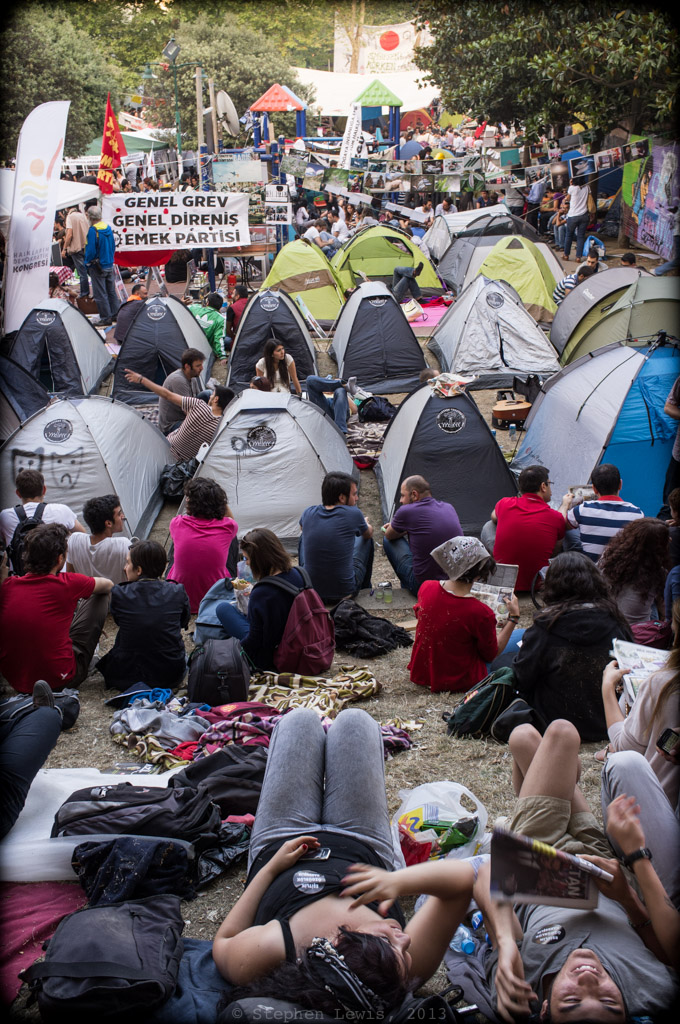
During the weeks it was extant, the Gezi Park encampment was organized and disciplined.  A committee of participating organizations put political differences far enough aside to ensure provision of essential services — sanitary, medical, and emergency.  Volunteers cooked and served in cafeteria-style kitchens well stocked with donated provisions.
Street Vendors
In addition to the means served to those encamped in the Gazi Park, the dense concentration of protestors, well-wishers, and the curious  attracted scores of ordinary street vendors.  Many such vendors were of types traditional to the streets of Istanbul — sellers of köfte, of  rice topped with shredded chicken, of hot boiled corn, and of circular bread rolls dusted with toasted sesame seeds (semit); others represented fast responses to the one-off needs of protesters.  The latter hawked Turkish flags and portraits of Atatürk, t-shirts emblazoned with slogans of protest, and simple painter’s masks and cheap swimming goggles, both passed off as protection against tear gas.  Beverage vendors did brisk businesses selling ice-cold bottled water and — rarely seen on the streets of Istanbul — beer.  Indeed, in the initial days of the occupation and demonstrations, polishing off a bottle of beer, as well as providing refreshment, was a principled statement of opposition to a regime intent furthering a sectarian-driven war to limit alcohol consumption. In the end, Gezi Park occupiers eventually banned beer vendors, this to disprove  the Turkish Prime Minister’s allegations of nightly drunkenness and debauchery in the protestors’ encampment.  According to one report, at least one beer vendor put up violent resistance to such expulsion, stabbing a protester in the process.)

Revolutionary melon slices for a revolutionary market. The slogan scratched onto the watermelon: "Taksim, the people's revolution is coming." But, no matter how progressive, red, and tasty such melon slices may have been, the going price -- five lira per serving -- was counter-revolutionary at best! (Fuji X100) (Click on image to enlarge).

Revolutionary melon slices for a revolutionary market. The slogan scratched onto the watermelon: “Taksim, the people’s revolution is on.” But, no matter how red and tasty such melon slices may have been, the going price — five lira per serving — was counter-revolutionary at best! (Fuji X100) (Click on image to enlarge).

Read More