Archive

Fuji X100 digital

Late-19th-century "çarșı"-style row house, Pirotska St., Sofia, Bulgaria, 2014. (Fuji x100). Click on image to enlarge.

Late-19th-century “çarșı”-style row house, Pirotska St., Sofia, Bulgaria, 2014. Note the neo-classical decorative elements and prim domesticity of the curtained windows on the second story and the presence of an Apteka (pharmacy) on the ground floor. (Fuji x100). Click on image to enlarge.

After the founding of an independent Bulgarian kingdom in the aftermath the Russo-Turkish War of the 1870s, the city of Sofia was chosen as the capital of the new nation-state.  The choice of Sofia comprises a tale unto itself.  True to the nation-state model, from day-one newly independent Bulgaria was giddy with dreams of expansion, northward, westward, and southward (to the east, expansion was blocked by the waters the Black Sea).  Sofia, located near Bulgaria’s western border, would be at the country’s epicenter if Bulgaria would succeed in realizing its revanchist “manifest destiny” by expanding westward to the Lake Ohrid and annexing all of Macedonia.

At the time, Sofia had not fully recovered from a heavy earthquake and ensuing epidemics during the first quarter of the nineteenth century.  The city boasted the palatial residence of the former Ottoman governor — soon to be re-purposed as the palace of a monarch recruited from a family of minor German “nobility”– and a main thoroughfare paved with ocher-colored bricks imported from abroad.  For the rest, however, Sofia’s streets were warrens of winding lanes centered around Friday mosques, neighborhood mesjids for daily prayer, churches, wells and fountains.

The first step in creating a self-styled European capital was to sweep away the old Ottoman neighborhood structure and cut a street plan in the western model.  The adopted plan combined a rectilinear street grid with a circular ring road and curving boulevards ala Hausmann’s plan for Paris.  The next step was true to the model of mono-ethnic nation state that Bulgaria was striving to become: “ethnic cleansing.  Gypsies and Jews, the latter comprising a full one-third of Sofia’s population of 10,000 at the time, were forcibly expelled from the city center; Jews to the newly cut parallel streets of  Üç Bunar (“Three Wells)” to the west of downtown Sofia, and Gypsies further outward to the far bank of the Vladaya river, one of several seasonally flooding streams that together formed a moat surrounding the city.

Amongst the new grid of streets cut from Sofia’s main north-south boulevard through the old Ottoman quarter of Sungur and out to Üç Bunar was Pirot, today Pirotska.  The downtown end of Pirotska eventually was lined with European-style apartment houses.  At the Üç Bunar end of Pirotska an older form of architecture still dominates: Two-to-three-story row-houses built in çarʂı (Turkish for “arcade” and “market”) style, with commercial space for shops and craftsmen’s ateliers on the ground floors and family dwellings on the floor(s) above.  Such çarʂı dwellings contributed to the re-shaping of Sofia by spatially integrating the functions of residential streets and  market quarters.  By doing so, they contributed to a culture of urban street life and the emergence of an urban middle- and lower-middle-class and paths to class mobility, both essential elements of democratic nation-building, an imperfect process in Bulgaria to this very day.
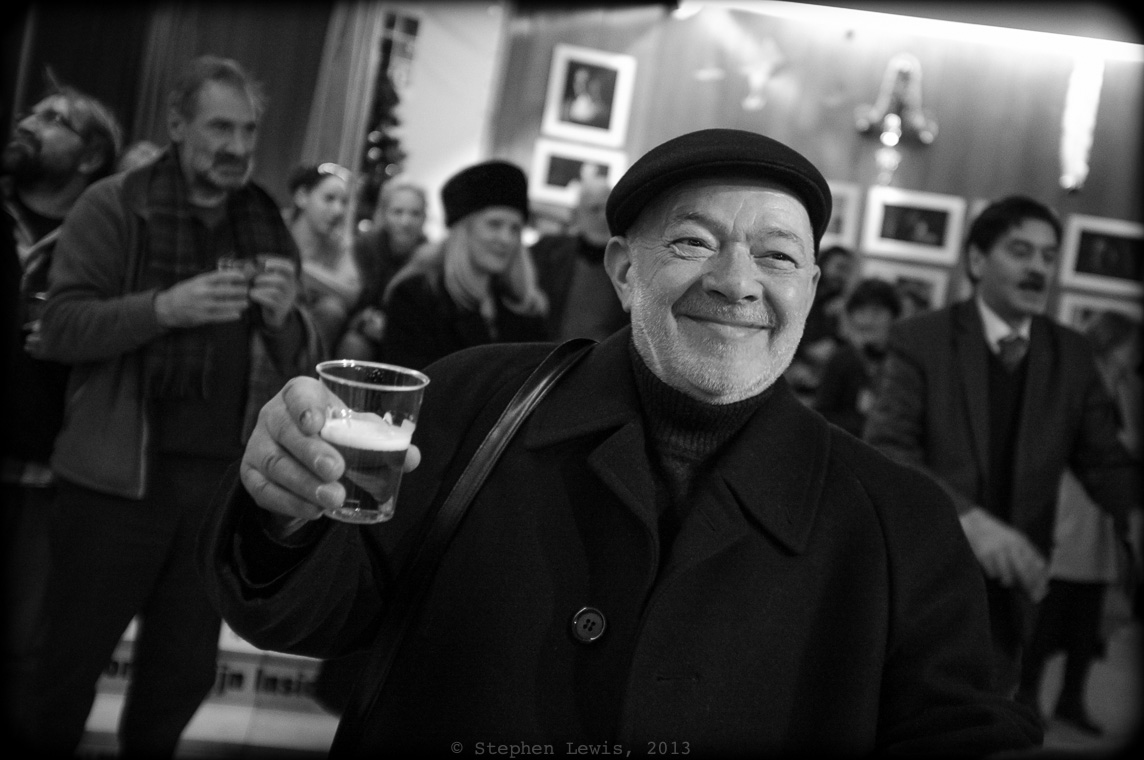
In the center, in one of his signature Hell's Angel-style caps, polymath and newly-minted octogenarian and maker of his own documentary films, Georgi "Johnny" Penkov, December, 2013. (Fuji X100, 1600ASA, "in camera" JPEG.)  Click on photo to enlarge.

In the center, in one of his signature Hell’s Angel-style caps, polymath and newly-minted octogenarian and maker of his own documentary films, Georgi “Johnny” Penkov, December, 2013. (Fuji X100, 1600ASA, “in camera” JPEG.) Click on photo to enlarge.

Wednesday evening I attended the premiere of two films in Sofia, Bulgaria, timed to honor the 80th birthday of Georgi “Johnny” Penkov — acoustical scientist, film sound man, humorist and raconteur, and, more recently, documentary film maker in his own right.

“My ‘Mahalla'” and a “Filibeli” guitarist

The first film was one Johnny shot, edited, and produced solo: “My Mahalla,” a characteristically humorous and touching, commentary-free sketch of details, rhythms, and sounds in the street in which he has lived his entire life (Mahalla being Turkish and colloquial Bulgarian for neighborhood).  The second film was one in which Johnny had served as sound man: “One Rainy Day,” an emotional and delicately shot  portrait of the brilliant, energetic, but, in recent years, reclusive, Bulgarian guitarist Ognian Videv, an autodidact and eternal “Filibeli” (after the Turkish word for a denizen of the city of Filibe — Plovidiv as it is now called — in Bulgarian Thrace).

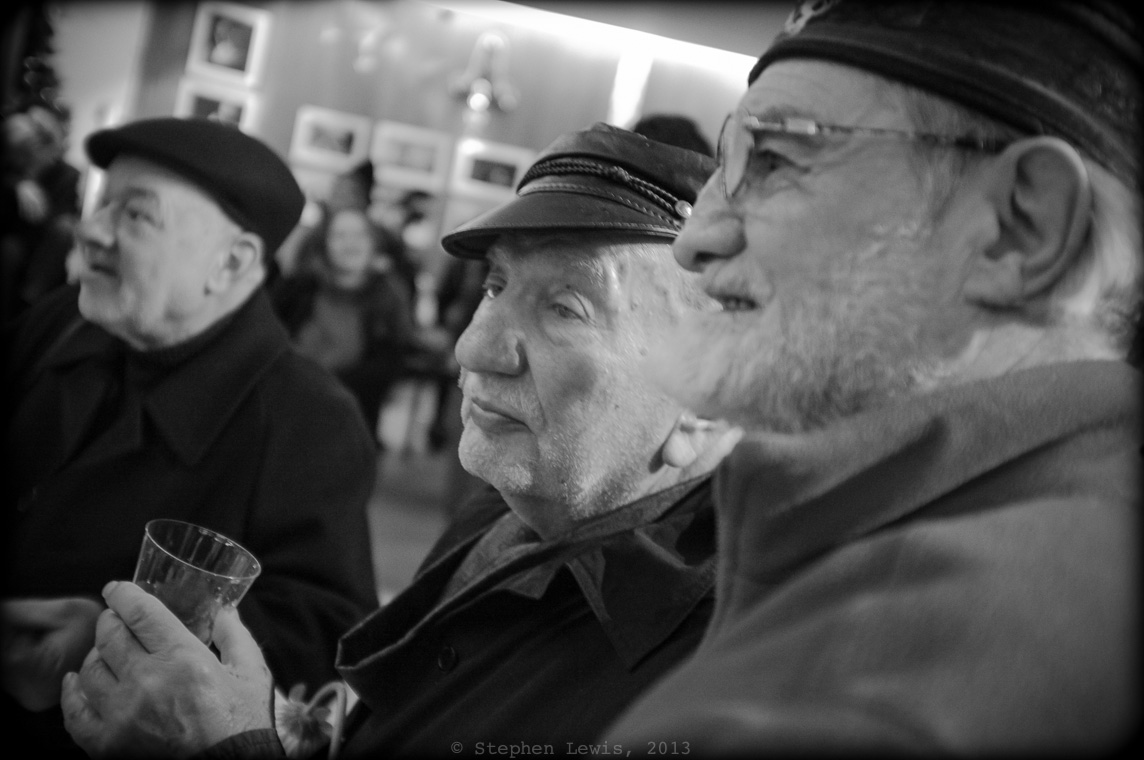
Legendary guitar Virtuoso and life-long "Filibeli" (see body text for definition), Ognian Videv, wearing an English-style Kangol and holding, in lieu of his signature guitar, a signature glass of bear, December, 2013.  (Fuji X100, specs as per above.) Click on photo to enlarge.

Legendary guitar virtuoso and life-long “Filibeli” (see body text for definition), Ognian Videv, wearing an English-style Kangol and holding, in lieu of his signature guitar, a signature glass of beer, December, 2013. (Fuji X100, specs as per above.) Click on photo to enlarge.

“Tvortsi” and polymaths

The premiere drew an older audience of past-generation Bulgarian “tvortsi” (“creatives,” as they were called during the communist period).  Some had been self-indulgent hacks and pretend former- dissidents in days gone by, contemptuous of ordinary people who work but incapable of working themselves. Others, however — like Johnny, Ognian, and the great Bulgarian-Jewish comic and dramatic actor Itzko Finzi (whose photo I unfortunately neglected to take) — were and remain hardworking, productive, world-class talents. They are also people from whom I learned much.  It was  Johnny, for example, who taught me that being a polymath is a specialization as worthy as any other (!) and who gave me the courage to continue on the path towards becoming one.  Not least, Johnny also honed my search for humor and insight in the small details.

Hats

In the days when many attending the premiere were far younger, hats were de rigeur for Soviet bloc “creatives” and were worn by some as a signature sign of their talents and by others as surrogates for real personae of their own.  Thus, five hats, each representative of people in the first category, are featured in the accompanying photos.

One-time cineast and eternal charmeur Doncho Papasov earned his eternal right to a "Greek fisherman's" hat by actually having once sailed solo around the world.  The faux-fur "kalpak" atop the head of blonde hair in the foreground added a "Ninotchka"-like touch of nostalgia and elegance. (FujiX100, specs as per above.) Click in photo to enlarge.

One-time cineaste and eternal charmeur Doncho Papasov earned his right to a “Greek fisherman’s” hat by actually having once sailed solo around the world. The faux-fur “kalpak” atop the head of blonde hair in the foreground added to the evening a “Ninotchka”-like touch of nostalgia and elegance. (FujiX100, specs as per above.) Click on photo to enlarge.

Photographic footnote: A confession of photographic laziness …

It was either laziness — or preoccupation with conversation with dancing, conversation, and decent wine at the reception following the screening — but the photos posted herein represent some uncharacteristic cutting of corners on my part.

First, my photo of Johnny is blurred and with no recognizable plane of focus.  Johnny would quite likely excuse this by saying that this actually makes  the photo more accurate, life itself being blurred and with no recognizable focus!  Second, instead of falling prey to my usual foible of thinking that the most complicated solution is the most worthy, I took an embarrassing post-processing short cut. Rather than converting my RAW files to b/w in Lightroom and carefully manipulating color sliders to achieve the look I desired, I converted them from RAW to monochrome JPEGS in-camera, using the raw conversion feature of the X100’s firmware.  The results, by the way, were far better than I had expected, especially considering that the files were shot at ISO1600.  All that was needed was some slight shifting of brightness, contrast, etc. in Lightroom,  plus a tad of added clarity and a drop of vignetting, the latter to draw the eye to the main subjects.  Luminance noise was — to borrow an adjective from internet photography pontificators — not unpleasantly “film-like.”

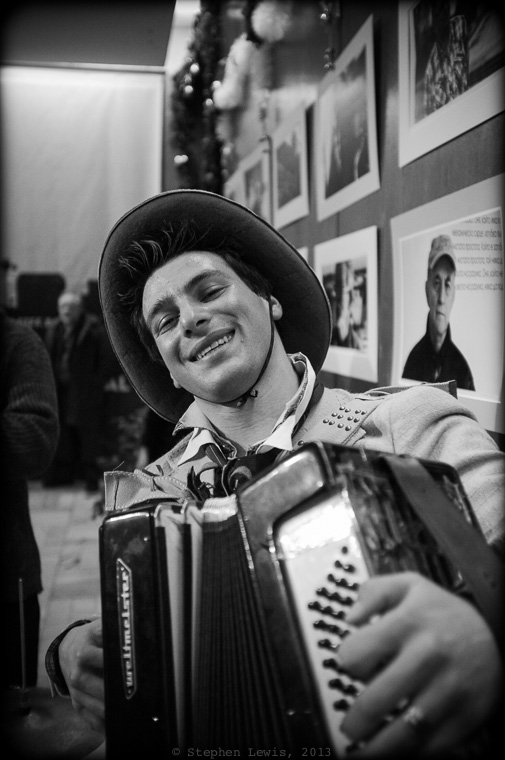
Music at the premiere was provided by a high-spirited, virtuoso Roma (Gypsy) accordionist, with the very non-Bulgarian, non-Roma name of "Jimmy."  Jimmy reinforces his seemingly American moniker with a seemingly American cowboy hate.  Johnny invited Jimmy to the premiere after hearing him play on the street nearby.  It was Jimmy's fault that I danced rather than photographed! (Fuji X100, specs as per above). Click on image to enlarge.

Music at the premiere was provided by Jesus Kotsev, a high-spirited, virtuoso Roma (Gypsy) accordionist, who goes by the very non-Bulgarian, non-Roma stage name of “Jimmy Accordeon.” Jimmy reinforces his seemingly American moniker with a seemingly American cowboy hat. Johnny invited Jimmy to the premiere after hearing him play on the street nearby. Blame it on Jimmy that I danced more than I photographed! (Fuji X100, specs as per above). Click on image to enlarge.

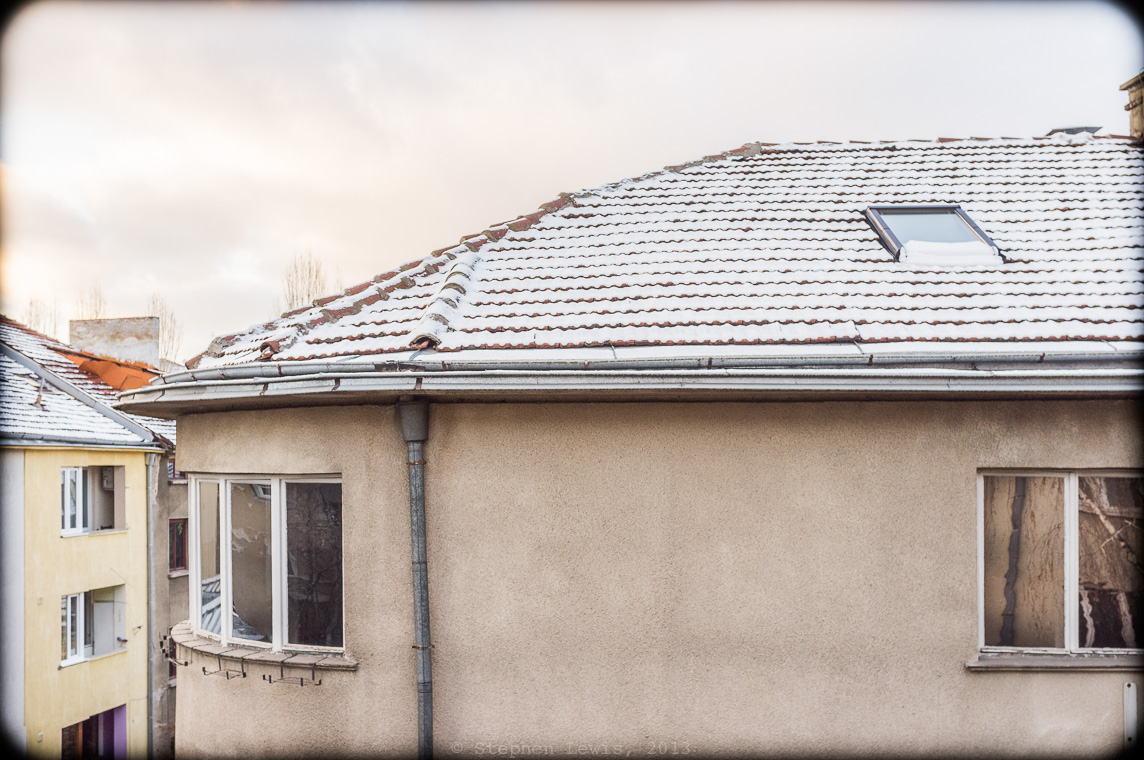
View from my desk at sunrise, Sofia, Bulgaria, winter 2011-2012. (Fuji X100).  Click to enlarge.

Sofia, Bulgaria, view from my desk at sunrise on a December morning, 2011.  (Fuji X100) Click to enlarge.

The image above shows the view from the desk I have been using during my stays in Sofia, Bulgaria over the last seventeen years.  For nearly two decades, the view has barely changed. The building on the far left received a coat of yellow paint some years ago, a window was cut into the roof of the building at the foreground and a birch tree that stood to the building’s left was felled during a storm.  However, the sensation I experience each time I glance out the window has remained constant — a feeling of floating above the city encased in a my own private bubble.

Even banal views belie tales of change. The above panorama of sky, roof tiles, distant trees, and the upper floors of Bauhaus-influenced facades may have remained fixed but life on the streets three stories below has gone through upheavals.  Competing political regimes and severe economic crisis have come and gone, Sofia’s population has increased 2.5x, a new generation of Sofia residents has been born and grown to near-adulthood, and the bulk of the economic and social lives of the city have moved out of the center to new areas at the urban periphery.

Seventy years ago, some of the rooftops in this very view were aflame during wartime aerial bombardments of Sofia. (Bulgaria, not to forget, was an enthusiastic ally of Nazi Germany and was fire-bombed by the British and Americans in reprisal, a matter cynically relegated to amnesia during both the Soviet- and post-Soviet eras).

During the years that the view above has been mine to enjoy, the building in the foreground has gone through several incarnations, all reflective of changes in the city at large. Soon after the denouement of the Communist period, during a time of unregulated gangster-capitalism, the building housed the offices of Bulgaria’s first GSM mobile telecommunications provider, initially owned by a succession of Russian and Israeli investors backed by dubious sources of capital.  Not long after, during a period of foreign largesse and a cargo-cult of NGO boondoggles, the building housed the Bulgarian representation of the United Nations Development Program.  Thereafter, the building remained vacant for some years until, this past month, it was refurbished to house private law offices.

Just as the view from my desk in Sofia points to stories of external changes, it also reveals changes in the viewer.  Over the years that I have used the desk, I’ve been in and out of Sofia as a mid-life Fulbright research scholar and photographer,  a convalescent and physical therapy patient following a severe accident,  a field worker for a US government project documenting aspects of the cultural heritage of ethnic and religious minorities, and  a consultant to various companies and institutions in Western and Central Europe. These last few months, I’ve been in Sofia for  time-consuming dental work, itself a revealing tale of sugar-laden, post-war American diet, prohibitively priced US dentistry, inadequate Western and Eastern European dentistry in the 1970s and 80s, past accidents, and poor luck at the roulette table of genetics.  I hope to be able to leave Sofia by mid-month — when I do, the memory of the view from my desk will travel with me.

An archway at the entrance of a tenement in the Tarlebaşı quarter of Istanbul, 2012. (Fuji X100) Click to enlarge.

An archway at the entrance of a tenement in the lower reaches of the Tarlebaşı quarter of Istanbul, 2012. (Fuji X100) Click to enlarge.

The streets sloping downward from the north side of present-day Istiklal Caddessi to Dolapdere Bulvari in the valley below are dense with late-19th- and early-20th-century tenements and apartment houses. Most are in disrepair but many have recently been restored as the area begins to undergo the preservationist benefits and human dislocations of gentrification and discovery by “cool” young westerners some oblivious of the lives of their neighbors and some enthralled by the seeming “romance” of the poverty … of others.

The area was built up in the late 19th century by Istanbul Christians, Greeks mostly.  It underwent a major demographic change following government-fomented anti-minority pogroms in 1956.  With the forced exit of Greeks, the neighborhood became a haven for the traditional inner city poor and recent arrivals from rural areas: Turkish Sunnis, Kurds, Alevis, and Roma.  The process of ghettoization was completed in the 1960s by the cutting of Tarlebaşı Bulvari, a multi-laned thoroughfare that served as a wall isolating streets immediately adjacent to Istiklal from those on the slope below.

A relationship between typology and geography  characterizes the area’s architecture.  As a rule of thumb, the closer to Istiklal, the larger the plot and grander the structure; the closer to Dolapdere, the smaller the plot and more modest the house.  The neighborhood’s apartment houses tend to be situated on the broader streets and its tenement row houses in smaller streets and alleyways. The closer to Dolapdere, the fewer and more modest the architectural decorative elements.  This makes the archway in the photo above all the more curious.

The archway above shows no relation to Ottoman styles nor to the geometric motifs of Anatolian Greek towns and villages.  In one way, it appears to be a fantasy interpretation of Mogul architecture.  More likely, given the time and the place, it might have been inspired by the so-called Moorish Revival style that arose in the Austro-Hungarian Empire following the Hapsburg annexation of Bosnia Herzegovina or, equally likely, by the eastern-influenced motifs of northern European Art Nouveau and Jugendstil.  By incorporating an ornament inspired by the popular European orientalist fantasies of the time, could the Greek owner or builder of the house in question have been trying to assert his own modernity and self-styled occidental individual identity, this at a time of when Ottoman Christians were focused on national independence ala European nation-states?

More on this theme in subsequent posts…

Former storefront, ground-floor of an abandoned late19th-century Greek-style apartment house,  Tahtakale, Eminönü, Istanbul, 2012.  (Fuji X100). Click to enlarge.

Former storefront, ground-floor of an abandoned late19th-century Greek-style apartment house, Tahtakale quarter, Eminönü, Istanbul, 2012. (Fuji X100). Click to enlarge.

A boarded-up storefront in a boarded-up building, a ghostly survivor in a once-thriving neighborhood. The brick façade of the ground floor and wood-plank-covered exterior of the upper floors suggest that the building may have been built and owned by Istanbul Greeks a century to a century-and-a-half ago.

Mattresses for sale, Tahtakale, Eminönü, Istanbul, 2012. (Fuji X100). Click to enlarge.

Mattresses for sale, Tahtakale quarter, Eminönü, Istanbul, 2012. (Fuji X100). Click to enlarge.

Exit Istanbul’s famed Egyptian Spice Market in the direction of the mosque of Rüstem Paşa and the neighborhood of Tahtakale and one passes through a narrow street filled with slow moving crowds of tourists and local shoppers from throughout the city.  The first few hundred meters of the street is lined with scores of shops selling fresh ground coffee, nuts and dried fruit, followed by stalls and workshops stocked with traditional wooden and metal kitchenware and folding tables, baskets, and other accoutrements de rigueur for street vendors.  Continue further in the direction of Unkapani and the crowds thin out and the goods in the shops and stalls become more prosaic and spartan, necessities geared to the mundane needs of low income shoppers from the immediate surroundings.  Artifice is absent, goods are displayed matter-of-factly — neither display windows nor vicarious seduction, no hawkers, just commerce at its most direct and unadorned.

Left: The wares of a broom seller with matching façade. Right: Affordable art.  Tahtakale, Eminönü, Istanbul, 2012. (Fuji X100). Click to enlarge.

Left: The wares of a broom seller with façade painted to match. Right: Affordable art. Tahtakale, Eminönü, Istanbul, 2012. (Fuji X100). Click to enlarge.


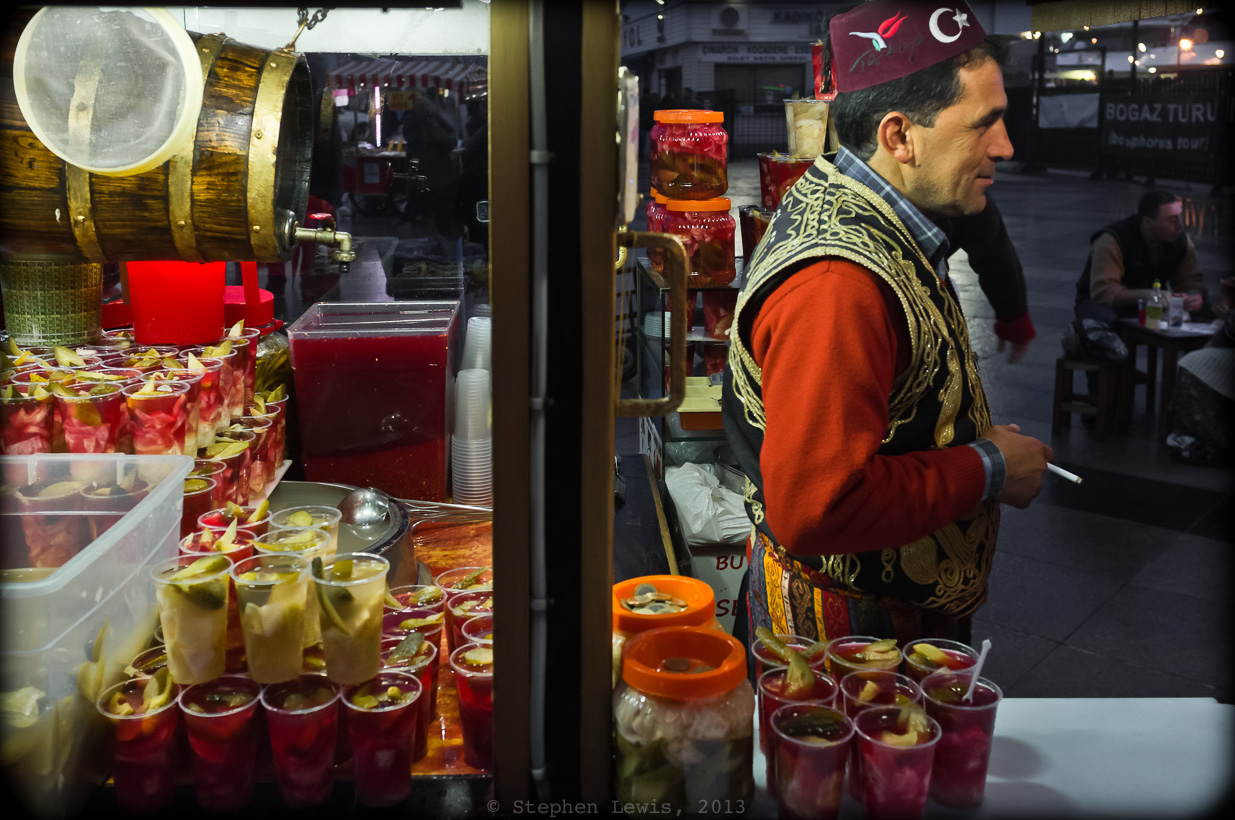
Pickle and pickle-juice vendor with stand prepared for the evening's trade, Eminönü, Istanbul, 2012. (Fuji X100). Click to enlarge.

Pickle and pickle-juice vendor with wares prepared  in advanced for the evening’s trade, Shore-front of the Golden Horn, Eminönü, Istanbul, 2012. (Fuji X100). Click to enlarge.

Invented Traditions

Over the last fifteen years or so, I’ve leisurely waded through the canon literature of the study of the emergence and solidification of nations and national identities: Benedict Anderson’s Imagined Communities, Eric Hobsbawm’s Invented Traditions, Pierre Nora’s five-volume study of the national memory of France, Patrick Geary”s The Myth of Nations, and, most recently,  Timothy Snyder’s powerful studies of identity and hegemony in Eastern Europe (Reconstructed Nations, Bloodlands, etc.), works that illuminate the translation of contrived national identities into viciously exclusionary and expansionist nation states.

A by-product of this reading is the realization that most “national” traditions — be they architectural, musical, dance, culinary, sartorial, folkloric, etc. — are either blatantly invented or appropriated from  traditions shared in common with neighboring peoples in an attempt to establish the legitimacy and hegemony of one’s own group at the expense the identity and power of others.  Invariably, such traditions are posited as being products of an imagined national “golden age.”

Pickles and Mackerel

So, what does the disquisition above have to do with pickles and grilled mackerel in Istanbul?

First, note  the costume worn by the pickle vendor in the photo at the top of this post:  a) an imitation fez made of cheap velvet rather than traditional wool felt, and emblazoned with the Turkish national crescent and star and with a stylized tulip, the latter a logo thought up for Turkey’s national tourism authority by a PR or “branding” agency; b) a mass produced embroidered vest of the sort sold to tourists in souvenir shops and bought in bulk by amateur folk-dance troupes; and c) a brightly colored waistband over wide pantaloons (the latter not visible in the photo).

A decade ago, the very same vendors dressed in normal street or work clothes and the carts from which they were sold were simple affairs of glass panes and unfinished or laminated wood.

At the water's edge: Neon-lit canopied faux-traditional caiques, floating kitchens preparing and serving grilled mackerel sandwiches to passersby. In the foreground, an angler in search for his own dinner. Illuminated in the far distance, the Süleymaniye, the mosque complex of Sultan Süleyman the Law-Giver ("Suleiman the Magnificent"), a master-work of the 16th-century architect Mimar Sinan. Galata Bridge, Istanbul, 2011. (Fuji X100). Click to enlarge.

Mid-distance at the water’s edge: Neon- and lcd-lit, faux-traditional, canopied launches — floating, wave-tossed kitchens grilling and serving  to passersby mackerel sandwiches garnished with lettuce and onions. In the foreground, an angler in search of his own fish dinner. Illuminated in the  distance, the Süleymaniye, the mosque complex of Sultan Süleyman the Law-Giver (“Suleiman the Magnificent”), a master-work of 16th-century architect Mimar Sinan. Galata Bridge looking across the mouth of the Golden Horn towards Eminönü, Istanbul, 2011. (Fuji X100). Click to enlarge.

Second, note the boats of grilled mackerel vendors moored at mid-distance in the second photo above.  The boats are topped with canopies in the shape of stylized fantasy imitations of those that once adorned the excursion launches of the Ottoman elite — with the addition of multicolored neon and incandescent lighting.  A decade ago, such boats were plain wooden skiffs with simple canvas or plywood roofs to block seasonal sun and rain.

I don’t remember exactly in which year this “make-over”of pickle vendors and mackerel boats occurred, nor am I certain why and at whose behest.  My guess is that it was mandated by the local district municipality or by the tourism functionaries of the municipality Istanbul.  More interesting is why ….

Read More

Galata Bridge, Istanbul Turkey, 2012. (Fuji X100) Click to enlarge.

Flower Vendor, Galata Bridge, Istanbul Turkey, December, 2011. In the background to the right: a few of the ubiquitous amateur anglers who line railings of the bridge year-round in expectation of an evening’s meal. (Fuji X100.) Click to enlarge.

The red flowers are kokina çiçeği. Kokina is a Turkish loan word from the Greek kokinos, meaning “red.”  In Istanbul kokina çiçeği are sold as New Years decorations, a custom borrowed from the city’s once-large and vibrant ethnic Greek population.  Botany is not my strong suit, but to me kokina çiçeği resemble a variety of mistletoe — not only in their appearance but also in their function as mid-winter talismans. In many ancient cultures, mistletoe varieties — especially those parasitic to oak — were associated with virility, fertility, and regeneration, part of the reason why, in the Anglo-Saxon world, men and women who pass together under Christmas-season mistletoe traditionally were compelled to kiss. Mistletoe may also have been the “golden bough” that Aeneas took with him as a placating gift on his trip to the underworld and, thus, the inspiration from which Sir James George Frazer’s took the name for his famed late-19th- early-20th-century study of myth land legend.  The flower seller, by the way, is an Istanbul Rom (Gypsy).  In much of southeast Europe, urban Roma labor long hours in the ornamental flower trade, as street vendors and, less visible to the casual stroller, as wholesalers as well.  Central and Eastern Europeans who accuse Roma of willful unemployment are blind to the those who labor at the base of the pyramid of urban economic activities.

Technical footnote…

When processing the raw file of this photo in Lightroom, I couldn’t resist the temptation to nudge the red-saturation slider slightly rightwards!

Cotton candy and toffee vendor at day's end.  Uskudar, Istanbul, Turkey, 2013. (Fuji X100.) Click to enlarge.

Almost sold out! Cotton candy and toffee vendor hastening home at day’s end. Ferry landing, Uskudar, Istanbul, Turkey, 2013. (Fuji X100, manually zone-focused while walking.) Click to enlarge.

Please indulge me while I repeat in short what most of us know quite well at length …

The last third of the 20th century saw the rise and flourishing  of socialism for the rich, generously financed by the taxes of those in the middle and working classes.  From America’s infamous Lockheed bailout in the 1970s to the billions of dollars in public funds poured into the craws of General Motors and banks “to big to fail” in the aftermath of the world financial implosion of 2008, large enterprises have been saved by funds cannibalized away from the expenditures on infrastructure and human resources on which our futures depend.  Small enterprises and individuals, on the other hand, are allowed to go under.  In Western Europe, semi-governmental lending institutions provide established companies with capital o expand and  commence new ventures.  Any one else who wants to obtain  capital and buy time to go “entrepreneurial” is left to their own devices and fed 19th-century platitudes about self-reliance and free markets. 

And now a few words about the photograph …

The photograph above shows a familiar presence in Istanbul: the wandering cotton candy vendor. His capital: a long pole, a box of pushpins, and a will to walk the parks and promenades of the city from dawn to dusk.   His stock: a few dozen bouquets of spun-sugar “cotton candy” and a few score cellophane bags of cheap toffee.  His income: minimal.  But the uncontrolled economic chaos of Istanbul at least gives him a chance to earn something.  In the US, he would be checked for his pedlar’s license, inspected for hygiene, and arrested for loitering if he stood still.  In Western Europe, he would have to follow months-long mandatory courses in retailing and management.  And, wherever he worked, if and when things went bad, he would be deemed “too small to be saved.”

A technical footnote …

One of the obsessions of many internet photography weblogs is the micro-second differences between automatic and manual focusing speeds of different makes and models of digital cameras. The photo above was taken using a notoriously “slow-focusing” camera — the Fuji X100 — by “zone-focusing” in advance in manual mode just as the vendor and I were approaching one another at a brisk pace.  Slow compared to cameras used by sports and wildlife photographers, most certainly, but no slower than my 1960s twin-lens Rolleis!

An infrastructural question: Will seaside boardwalks survive the 21st century?

A look at the New York region suggests that they might not.  The resurgence of nature over urban artifice during last year’s Hurricane Sandy revealed anew the importance of regeneration and/or conservancy of natural coastlines.  The flooding that devastated nearby Long Beach on the south shore of Long Island, for example, would have been avoided or minimized had natural sand dunes still been in place that were removed early in the twentieth century to clear the way for apartments with oceanside frontage and the construction of a magnificent miles-long boardwalk promenade.  This year’s fire to the south of New York City on New Jersey’s Atlantic shore owed its rapid spread to the very materials that give boardwalks their name: wood-plank paving.   And, yet, boardwalks remain urban necessities.

Shuttered monument to a forgotten Brooklyn politician: Abe Stark Sport Center, Boardwalk, Coney Island-Brighton Beach, 2011. (Fuji X100)

Shuttered monument to a forgotten Brooklyn politician: Abe Stark Sport Center, Boardwalk, Coney Island-Brighton Beach, 2011.(Fuji X100.)  In the foreground: the characteristic herringbone wood planking of New York City boardwalks and a lone dented trash barrel painted in the signature green of the NYC Dept. of Parks.

From fashion to survival

Boardwalks are products of the interstice of 19th-century romanticism and 19th-century urbanity, in which nature was a picturesque backdrop to be seen but not touched, to be witnessed — but with dry and unsoiled shoes — from the safety and elegance of seaside promenades and beach-front hotels and restaurants. In the context of the lives of millions of ordinary New Yorkers — this writer and two generations of his forebears included — the boardwalk at Coney Island was and remains central to urban survival.   Like Manhattan’s Central Park and Brooklyn’s Prospect Park, the Coney Island boardwalk from Brighton Beach past Coney Island to Seagate gives New Yorkers who lack the means to vacation or to travel afar access to fresh air and a refuge from urban congestion and searing summer heat.

Outlets to the sea

The Coney Island boardwalk was built ninety years ago, a time when the farmlands of Brooklyn were being paved over en masse for the construction of seemingly endless expanses of working- and lower-middle-class apartments for immigrants and their children fleeing cramped, degrading housing conditions in lower Manhattan.  Their flight followed the paths of newly built subways lines, trajectories that gave also gave shape to the schemes of real estate speculators.   The continuation of subway lines to the seaside, and thus to Coney Island, afforded the urban working poor an easy outlet to the beach and to walks and leisurely socializing on surfaces less oppressive than urban concrete, and to sounds less intrusive than the ever-present rattling of horse carts and, later, the roar of automobiles.

Changing numbers, changing faces

Over the last century, usage of the Coney Island boardwalk has fluctuated in parallel with the fortunes and changing demographics of its immediate hinterland.  (A lengthy subject that I will save for future posts.)  The apogee of the boardwalk’s crowds and popularity was in the 1930s and early 1940s.  A decline set in after the Second World War and continued through 1970s.  A revival was sparked in the late-1970s, in part by the settlement in Brighton Beach of tens of thousands of mostly Jewish immigrants from the Soviet Union.  Over the past decades, the faces seen, and accents and languages heard, along the boardwalk have changed from those of Jews, Irish, and Italians — once amongst the dominant ethnic groups in New York — to those of African-Americans, Puerto Ricans and Dominicans, Russians, Central Asians, Indians, Pakistanis, Mexicans, and Chinese.  What has remained constant is the precarious place of boardwalk denizens towards the lower rungs of New York City’s housing and economy.

From infrastructure to serendipity

During the 1930s and early-40s, under President Roosevelt’s New Deal and the mayor-ship of Fiorello LaGuardia, investment in and maintenance of public infrastructure, both physical and social, was seen as a core task of government – – a means for collectively facilitating the lives and advancement of all individuals comprising our society and, not least, ensuring social peace in the process.  Parks, beaches, and boardwalks included, were parts of the mix.

America's shoreline: John"s Italian Ices and a tattered US flag. Sunset at the Coney Island Boardwalk, 2011. (Fuji X100)

America’s shoreline: John”s Italian Ices and a tattered US flag. Sunset at the Coney Island Boardwalk, 2011. (Fuji X100)

“Fast forward” to the years of New York as financial center and the Bloomberg years, the age of a real-estate-development-driven economy, increasing unequal distribution of wealth, and “Manhattanization” (a new phrase coined to describe the phenomenon of a economically and demographically variegated city or part thereof suddenly turning into a preserve of those at the upper income levels, this a la the fate of much of Manhattan since the start of the millennium).

Over the last decade, social and physical infrastructure and their maintenance are increasingly surrendered to private enterprises or left to the serendipitous voluntarism of “public private partnerships.”   One of the results has been the filleting of the public funds for parks maintenance and the establishment in place thereof of “public-private partnerships” in the form of “conservancies” linked to individual properties.  The outcome has been predictable.  Manhattan’s Central Park, the city’s highest profile park facility, flanked by three of New York’s wealthiest district is governed and funded by a conservation with an immense endowment and budget.  Brooklyn’s Prospect Park Conservancy struggles to cover costs and many of the parks facilities still dependent on filleted public funds languish.

“Let them walk on concrete:”

Wood paved boardwalks splinter, warp, and rot, they are maintenance intensive and require periodic resurfacing.  In the spirit of Marie Antoinette advising the bread-starved poor of pre-revolutionary Paris  “… let them eat cake,”  the Bloomberg era’s prescription for the patrons of the Brighton Beach-Coney Island boardwalk appeared to be: “… let them walk on concrete.”   A couple of years ago, large sections of the boardwalk surface were stripped of their wood and replaced by prefabricated modular sections of light-colored concrete with surfaces crudely textured to give the impression of wood grain.  The modular sections were poorly leveled and sloppily abutted.

The immediate reaction?  Small crowds of boardwalk denizens gathered in amazement and  Read More