Archive

Architecture

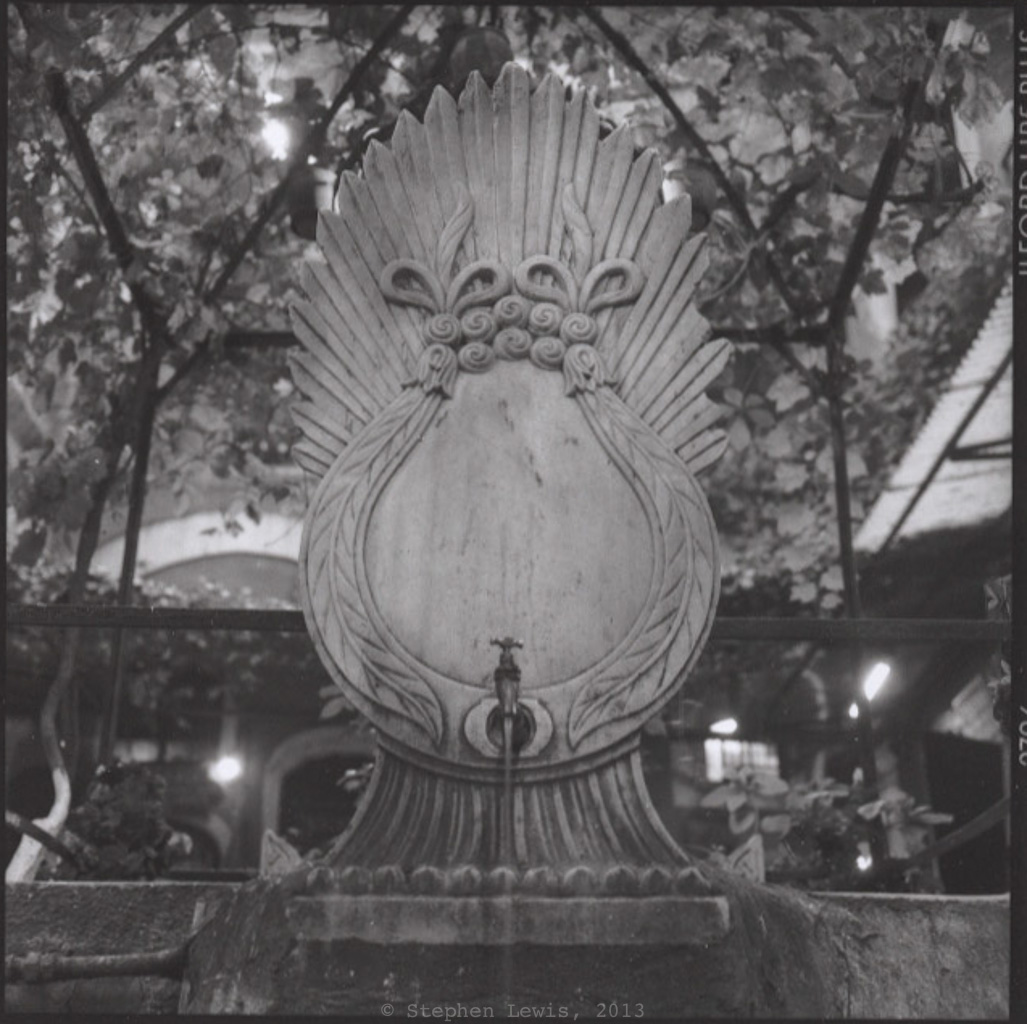
Derelict fountain, Galata, Istanbul, ca. 2000. (Rolleiflex Xenotar f2.8, Ilford HP5, scan of print.)  Click to enlarge.

Derelict fountain, Galata, Istanbul, ca. 2000. (Rolleiflex Xenotar f2.8, Ilford HP5, scan of print.) Click to enlarge.

Further to my previous post on water, fountains, et. al.

Processes of decline and abandonment

Two decades ago, I began to photograph the historic water fountains (çeșme) and water kiosks (sebil) of Istanbul.  I began, not with the grand and monumental, but with obscure and abandoned — those in backstreets, alleyways, and courtyards, functioning and non-functioning fragments of legacy urban infrastructure, overlooked by scholars,  their features surrendered to the elements, decay, and neglect. The forgotten origins and gradual disappearance of many of these structures seemed symbolic of larger urban processes of decline and abandonment — processes that are as central to the functioning and continuity of cities as are restoration and (re)development.

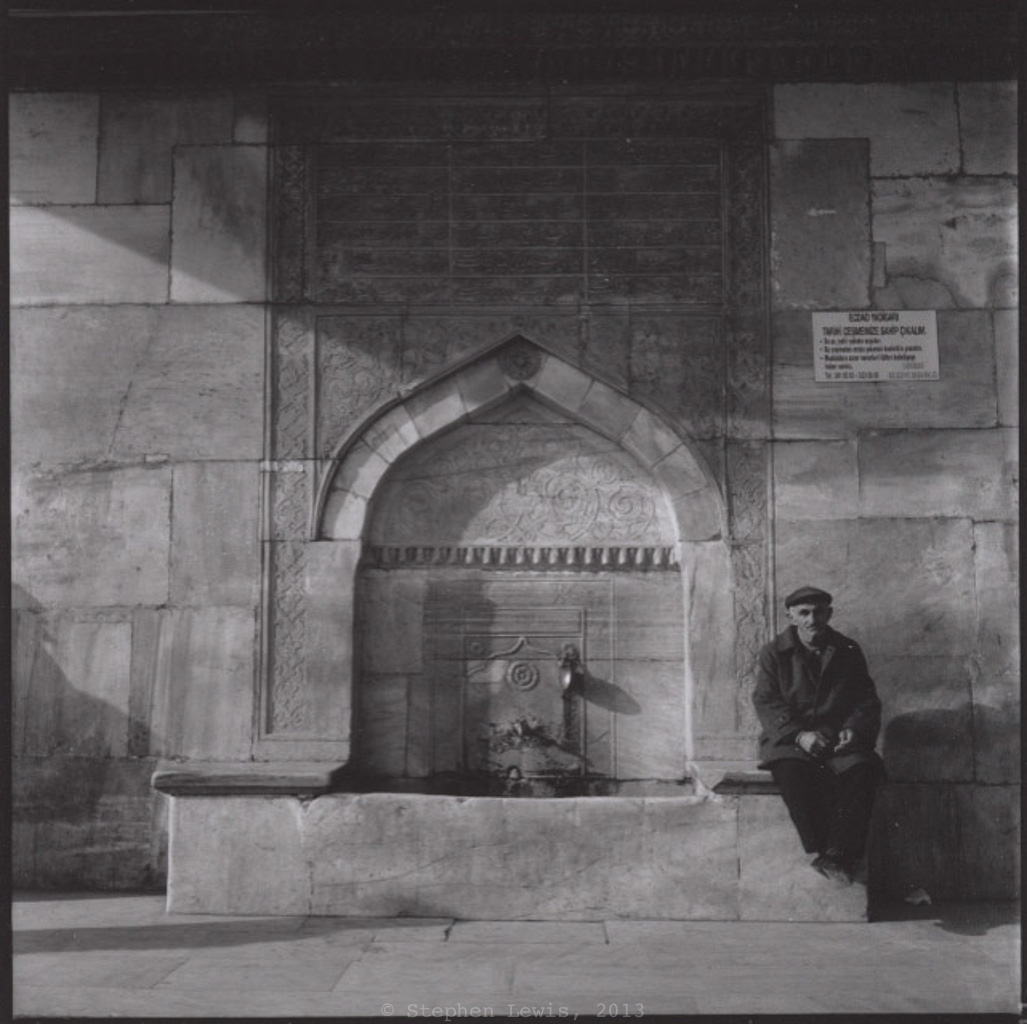
Fountain, seemingly from late-18th-century spolia, Zincirli Han, Kapalı Çarşıı, Istanbul, ca. 2000. (Rolleiflex Xenotar 2.8, Ilford XP2, scan of print.) Click to enlarge.

Fountain, seemingly from late-18th-century spolia, Zincirli Han, Kapalı Çarşı, Istanbul, ca. 2000. (Rolleiflex Xenotar 2.8, Ilford XP2, scan of print.) Click to enlarge.

Aesthetic rather than documentary

At the time, my approach to fountains and kiosks aesthetic rather than documentary.  My eye was drawn to single planes as much as to entire structures, to textures as much as to decorative elements, to materials and much as to settings, and to the marks of time as much as to original appearances.  The joy of finding in the focusing screens of my Rolleiflexes the tensions and calming balances inherent to subject matter was paramount.

Frontal detail of the early-eighteenth-century Iskele (quayside) fountain, Uskudar, Istanbul, 1997. (Rolleiflex Tessar f3.5, Ilford HP5, scan of print). Click to enlarge.

Frontal detail of the early-eighteenth-century Iskele (quayside) fountain, Uskudar, Istanbul, 1997. (Rolleiflex Tessar f3.5, Ilford HP5, scan of print). Click to enlarge.

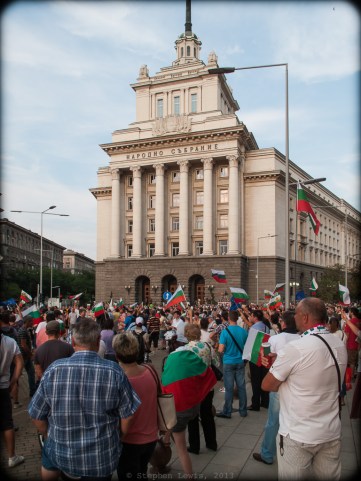
Sofia, Bulgaria.  Demonstrators gathering on a recent weekday evening in front of the National Assembly Building, a "Stalinist Wedding Cake" style edifice that during the years of the Soviet Bloc housed the headquarters of the Bulgarian Communist Party.  Out of frame to the left: The offices the Bulgarian Council of Ministers.  Out of frame to the right: The offices of the President of the Republic of Bulgaria. The National Assembly Building, by the way, stands at the very epicenter of Sofia, at the convergence of three ages-old roadways around which the city rose, at the remains of the east gate of the Roman city of Serdica, and at the foot of a rise upon which, during Ottoman times, stood the clock tower that regulated the city's pace.  (Canon G10) (Click to enlarge.)

Sofia, Bulgaria. Demonstrators gathering on a recent weekday evening in front of the National Assembly building, a “Stalinist Wedding Cake” style edifice that during the years of the Soviet Bloc housed the headquarters of the Bulgarian Communist Party. Out of frame to the left: The offices the Bulgarian Council of Ministers. Out of frame to the right: The offices of the President of the Republic of Bulgaria. The National Assembly building, by the way, stands at the very epicenter of Sofia: at the intersection of three ages-old roadways around which the city first arose; at the remains of the east gate of the Roman city of Serdica, the precursor to what is now Sofia; and at the foot of the rise upon which, during late-Ottoman times, stood the clock tower that once regulated the city’s pace. (Canon G10) (Click to enlarge.)

In Bulgaria, I have learned, nothing is what is seems to be at first glance, and words, no matter how clear, often refer to alternate realities (click here for my long-ago online discourse on the wisdom and convenience of the oft-heard Bulgarian-language phrase po printsip, tr. “in principle”).

A Government Resigns

During my last visit to the Bulgarian capital, Sofia, back in February and early-March of this year, demonstrators poured into the center of the city to join marches protesting over-inflated energy charges, these resulting from a cynical game of arbitrage and manipulation of subsidies by insiders.  The demonstrations differed from the norm in that, this time, the majority of the marchers were from the Soviet-bloc-era housing developments at the fringes of Sofia — low income people, thus, caught in a squeeze between minimal incomes, lack of savings, and the soaring prices of inelastic monthly expenses.

The February and March demonstrations led to the cavalier resignation of the right-of-center government of Prime Minister Boyko Borisov, a Communist-era  one-time state security heavy and a recent mayor of Sofia whose shaved skull, protruding jaw, and characteristic bombast are reminiscent of Mussolini.  “Brother Boyko,” as he sometimes is called, simply threw up his hands and called for elections, thus, in effect, abandoning the country and dumping the entire mess into someone else’s lap.

Government by “Strange Bedfellows”

As Shakespeare wrote in The Tempest: “ … misery acquaints a man with strange bedfellows;” likewise the coupling that comprises the government formed to replace that of Brother Boyko.  Current coalition partners include the BSP (successors to the old Bulgarian Communist Party) plus two small parties that survive by playing the roles of coalition-brokers: the DPS (Movement for Rights and Freedoms, a party originally founded to defend Bulgaria’s million-strong Turkish and Muslim minority against state and social oppression) and ATAKA (an out and out neo-nazi party whose platform and appeal is based on anti-Semitism and hatred and disenfranchisement of Bulgaria’s large populations of Gypsies and Turks).

One of the first acts of the new coalition was inexplicable, even by Bulgarian standards: The appointment of an oligarch with known ties to organized crime as head of the country’s national security agency.   In response, one month ago, crowds took to the streets of Sofia and of cities and towns elsewhere in Bulgaria in daily protest marches.  Within ten days, the appointment was withdrawn just as inexplicably as it been made in the first place.  The demonstrations, however, have continued.

Thinking Balkan

And this brings us back to my opening paragraph above: the Balkan blurring of what is said and what is, and what is and what could or should be.

One of my local interlocutors, a successful medical practitioner, explains that the demonstrations are an uprising of the new middle class.  Another — an energetic and articulate young independent consultant — adds that the demonstrations represent the entry of her generation into the politic arena.  And yet, when I visit the demonstrations, what I notice are embittered folks, in large part pensioners and the seemingly un- or under-employed, as well as a sprinkling of deadbeats swilling from liter bottles of beer or wearing t-shirts decorated with iron crosses or other iconography of the know-nothing right.  The signs I read and slogans I hear at the demonstrations are mostly rants against communism; the communist period, by the way, having ended one year short of a quarter of a century ago.  A sprinkling of English-language signs, featuring liberal use of words such as “motherfuckers” and “bastards,”  reveals the tenor of discourse.

A friend of mine who is a close observer of of local Facebook activity and print and broadcast media offers another take, i.e. that the protests have offered the media-savvy a low-risk opportunity to engage in “reputation management” and profile themselves as a new class of courageous leadership.  She also suggests that the demonstrations are likely to be used by Brother Boyko as a pretense for a magnanimous return to power.  Another friend — a former communist and present-day socialist, who has always had the integrity to speak out against the abuses of both parties — regrets that recriminations and shapeless discontent seem to be the language and output of-the-day of the Sofia protests, rather than a focus on concrete issues or the formation of a sustainable new opposition, this unlike contemporaneous events in Istanbul (see my previous post on issues and aspersions).  A third friend, a woman who has worked in the private sector in Bulgaria from the very first days of post-communist “market” economy, emphasizes that no party directly confronts the core issue of a divorcing government and the economy-at-large from organized crime.

Tomatoes, “Feta,” Schnapps, and Comments

As to me, I’m yet sure what I think — except, of course, not to trust my first impressions.  My next step, thus, will be to get myself back to thinking Balkan.  So, for the coming days at least, I’ll simply continue to enjoy the cool weather and refreshing periodic thunder storms and lose myself in the excellent local tomatoes, “feta,” and schnapps.  While I do so, please feel free to post your comment(s), whether in English or Bulgarian.

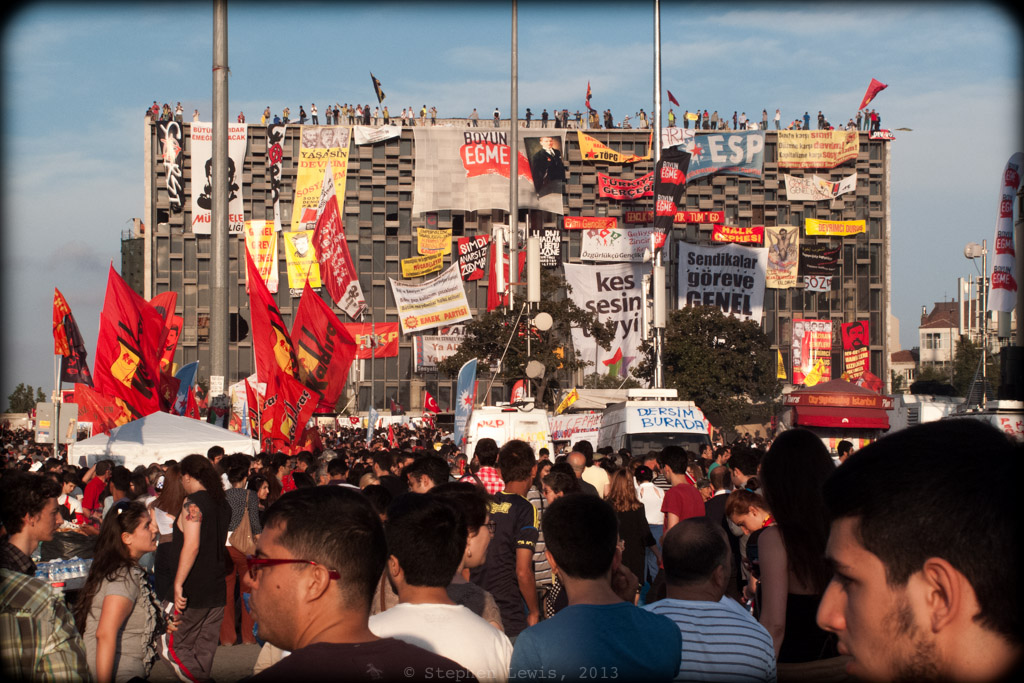
Atatürk Cultural Center, Taksim Square, Istanbul, occupied and bedecked with banners of left wing groups, early-June 2013. (Canon G10) (Click on photo for larger image.)

Atatürk Cultural Center, Taksim Square, Istanbul,  bedecked with banners of left wing groups, Gezi Park occupation, early-June 2013. (Canon G10) (Click on photo to enlarge image.)

This past Saturday night, police once again ran amok in Taksim Square, Istanbul, using tear gas and high-pressure streams of chemically tainted water to drive away protesters.  The attack was minor, however, in comparison with the police’s violent ejection of occupiers and visitors to Gezi Park the Saturday before and their night-long violent siege of Taksim five days earlier.

A Change of Banners

During the two-week-long occupation of Gezi Park, adjacent Taksim Square was a locus of protest for left-wing demonstrators, many of them representatives of fragmented parties driven   ideologies more than  constituencies. As part of the Gezi occupation, a group of protesters took over the long-abandoned Atatürk Cultural Center building, a 1960s structure fronting on Taksim.  The steel-lattice-covered facade of the Atatürk Center made a perfect multistory bulletin-board for the banners of revolutionary sub-sects.  The first act of the Police upon clearing the Center of occupiers was to remove their banners and replace them with a triptych of a giant prim portrait of Atatürk flanked by two equally immense Turkish flags.  This ensemble conspicuously lacked the immense portrait of Turkey’s Prime Minister that is usually hung alongside that of Atatürk at the his outdoor rallies and as a backdrop to his lengthy television addresses).


Atatürk Curlutral Center, the morning after a brutal siege by police a week and a half ago.  Immediately after the siege, the police removed banners hung by left-wing groups and replaced them with a portrait of Atatürk flanked by two Turkish flags.  In an uncharacteristic departure from the usual iconography of of the present regime, a portrait of Prime Minister Erdoğan is conspicuous in its absence. (Fuji X100).  (To magnify image, click on photo)

Atatürk Cultural Center, the morning after a brutal siege by police a week and a half ago. Immediately after the siege, the police removed banners hung by left-wing groups and replaced them with a portrait of Atatürk flanked by two Turkish flags. In an uncharacteristic departure from the usual iconography of of the present regime, a portrait of Prime Minister Erdoğan is conspicuous by its absence. (Fuji X100). (To magnify image, click on photo)

Issues Crystallize Discontents

The occupation, demonstrations,  vigils, and battles around Gezi Park and Taksim Square this month provided a political and physical rallying point for overall discontent with the authoritarianism and sectarianism of the Erdogan regime and with its aggressive contempt for that half of the Turkish polity who do not support it.  Underlying this broader discontent were several sets of concrete issues that kicked-off the protests in the first place, including the relationship of policy-makers and profit-makers in the urban sphere, and the nature, ownership, and future of the urban landscape (more on this in a subsequent post).

Iconography of Urban Space

A subset of these issues involves the iconography of urban space and urban constructs.  For decades, Taksim has been destination and site for political marches, celebrations, and (all too often violently repressed) protests. Taksim, thus is  a  symbol of both the political cohesion and the political and social conflicts of the Turkish Republic.  The present plans of the Erdogan government to replace this meaning-charged open space with a full-sized replica of a late-Ottoman-Empire military barracks razed a century ago speaks volumes about the political, social, and cultural attitudes and intents of the present government, as does the government’s plan to demolish the Atatürk Center, once venue for concerts, opera, and theater, and named after the founder of the modern, secular Turkish Republic.  The reconstructed barracks, by the way, is slated to be one element of of a giant shopping-center and mosque complex planned to obliterate the footprint of what are now Gezi Park, Taksim Square, and the Atatürk Center.

Read More