Archive

Architecture

Former storefront, ground-floor of an abandoned late19th-century Greek-style apartment house,  Tahtakale, Eminönü, Istanbul, 2012.  (Fuji X100). Click to enlarge.

Former storefront, ground-floor of an abandoned late19th-century Greek-style apartment house, Tahtakale quarter, Eminönü, Istanbul, 2012. (Fuji X100). Click to enlarge.

A boarded-up storefront in a boarded-up building, a ghostly survivor in a once-thriving neighborhood. The brick façade of the ground floor and wood-plank-covered exterior of the upper floors suggest that the building may have been built and owned by Istanbul Greeks a century to a century-and-a-half ago.

"La Reina." The Queen of Latin Music, Celia Cruz.  Wall painting, low-100s between Lexington and Third, Manhattan, 2012. (Fuji X100). Click to enlarge.

“La Reina.” The Queen of Latin Music, Celia Cruz. Wall painting, low-100s between Lexington and Third Avenues, Manhattan, 2012. (Fuji X100). Click to enlarge.

The great Afro-Cuban singer Celia Cruz, one of the voices of Latin Music during the second half of the twentieth century.

The portrait above graces a tenement wall at the western edge of Spanish Harlem.  The tenements of Spanish Harlem were built more than a century ago to capitalize on flows of immigrants and their children attempting to escape the  congestion and degradation of the Lower East Side. (One of own grandmothers lived for a few years only a block away from the wall on which the portrait above is painted.)  Most of the first wave of East Siders to arrive in the neighborhood (Jews and Italians, mostly) soon moved northwards following the routes of new subway lines to housing that arose in the Bronx in the years after World War I.

By the 1940s, Spanish Harlem had become the main destination for migrants to New York City from Puerto Rico.  In the 1950s and 60s, some blocks of Spanish Harlem were amongst the poorest, most crowded and densely populated places on earth.  In recent years the population of the neighborhood has thinned out and, in places, gentrification has begun. Nevertheless, the voice of Celia Cruz still echos resonantly.

Gino Flea Market, New & Used, West 168th Street, Bronx, New York, 2012. (Fuji X100) Click to enlarge

Gino Flea Market, New & Used, West 168th Street, Bronx, New York, 2012. (Fuji X100) Click to enlarge

Retailing at the urban edge, beyond the rapacious locational analyses of chain and big-box stores.  Recycled goods, low-value inventories, uncertain provenance, low-rent locations, minimalist architecture, utilitarian displays, and clientele low on disposable cash.  (NB: Those who delight in the idiosyncratic orthography and grammar  of NYC signage will note the absence of a possessive apostrophy-s appended to Gino.)

Recommended in this context: Bronx Bodega by the inimitable gurus of urbanism, the “Internets Celebrities,” Dallas Penn and Rafi Kamm.

Art Deco west Bronx: Noonan Plaza, Highbridge Heights, Bronx, NY.  Constructed, 1931.  Architect, Horace Ginsbern. Photograph, 2012. (Fuji X100) Click to enlarge,

Neo-Mayan Art Deco  Bronx: Noonan Plaza, W. 168th St. Highbridge Heights, Bronx, NY. Constructed, 1931. Architect, Horace Ginsbern. Photograph, 2012. (Fuji X100) Click to enlarge,

Facades of the West Bronx, a modernist entree into America and into real and illusory dreams of social mobility for hundreds of thousands fleeing the oppression and degradation of the Lower East Side more than three-quarters of a century ago. Linear design, economy (or penury?) of materials, and just enough ornamentation to break monotony and enable fantasy.  For a new generation of inhabitants arriving in the 1970s, such facades comprised the grim face of a socioeconomic ghetto in decline.  As to the future: May this neighborhood remain a place for those who fight their way up, rather than of gentrifiers who usurp and flatten through economic privilege and disposable cash.

Detail, Service Entrance, Mayan-inspired terracotta tiles, Park Plaza Apartments, Jerome Avenue, Highbridge Heights, Bronx, New York.  Constructed: 1929-1931.  Architects: Horace Ginsbern, Marvin Fine. The six-pack of Heineken is fortuitous.  2012. (Fuji X100). Click to enlarge.

Detail, Service Entrance, Mayan-inspired terracotta tiles, Park Plaza Apartments, Jerome Avenue, Highbridge Heights, Bronx, New York. Constructed: 1929-1931. Architects: Horace Ginsbern, Marvin Fine. The six-pack of Heineken is fortuitous. 2012. (Fuji X100). Click to enlarge.

From: White, Norval; Willensky, Elliot; Leadon, Fran (2010-05-29). AIA Guide to New York City, Oxford University Press. Kindle Edition:

Noonan Apartments

“These seven-story apartments, arranged to form a quadrangle, are entered diagonally through a highly decorative masonry arcade that leads to a central court, the original splendors of which can only be guessed at today. Art Deco-cumMayan was then the idiosyncratic style of the Ginsbern firm.”

Park Plaza Apartments

“One of the earliest (and best) Art Deco–inspired apartment buildings in the Bronx. Influenced both by the 1925 Exposition Internationale des Arts Décoratifs et Industriels Modernes in Paris, and motifs from Mayan architecture then fashionable. Note the elaborate polychromed terracotta ornament. The façade is Fine’s work, the body Ginsbern’s.”

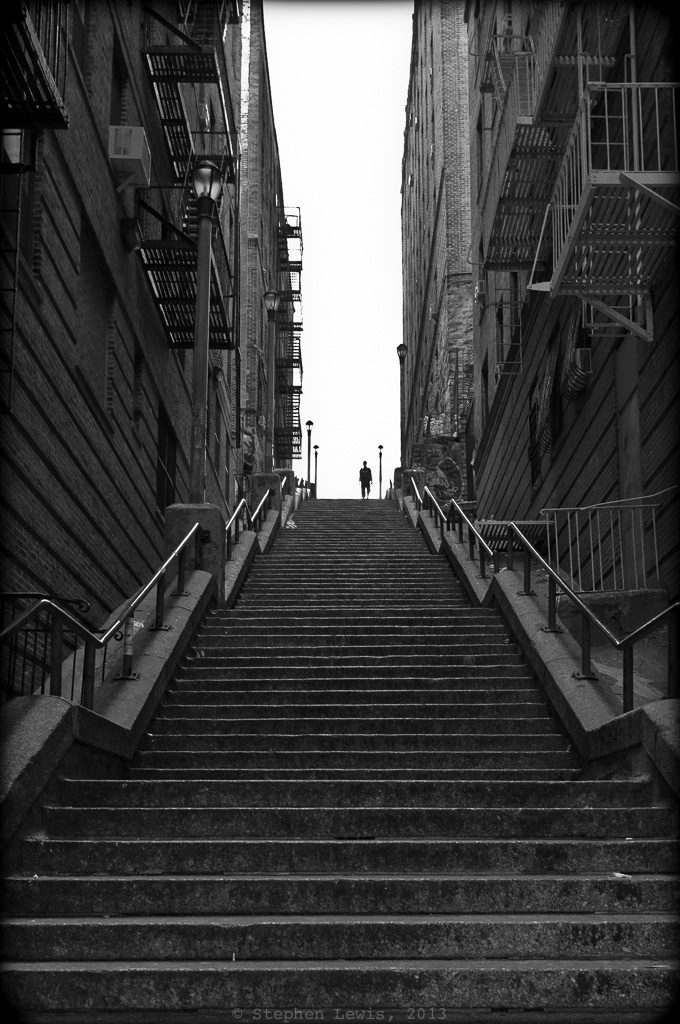
The streets of the west Bronx meander upwards on their ascent to the heights above the Harlem River.  Their winding curves are transected by linear alleyways and stairways that reveal the brash geometry and uncompromising textures that underlies the stylized art deco facades for which the neighborhood is known.  Anderson Avenue, 2012. (FujiX100) Click to enlarge.

The streets of the west Bronx meander upwards on their ascent to the heights above the Harlem River. Their winding curves are transected by linear alleyways and stairways that reveal the brash geometry and uncompromising textures that comprise the reality behind the stylized art deco facades for which the neighborhood is known. Anderson Avenue, Bronx, NY, 2012. (FujiX100) Click to enlarge.

In the headline above, I’ve intentionally left out Miss Gladys’s family name.  No matter.  Even if I’d included it, you wouldn’t find Miss Gladys on the internet or in books or newspaper archives.  You can, however,  find Miss Gladys deep in the hearts and memories of scores of people in the Bronx and in Harlem.  And, to search these, no last names are required.

Miss Gladys passed away two years ago yesterday.  As per the title of this post, her life was one of ascent through a world as stark and roughly surfaced as the stairways and alleyways of the Bronx.  In it bare-bones outline, Miss Gladys’s biography was paradigmatic of many African-American women of her generation: Born in the south, traumas at a young age, a move north, single motherhood, years of hard work while studying to become a nurse, disability from an on-the-job accident, and a final earthly rise into the rarefied world of Alzheimer’s.  Miss Gladys’s ascent through life was as steep, deliberate, and demanding as that of the stairways that slice through the west Bronx.  Miss Gladys climbed her way upwards with outspokenness, arch humor, and energy, and with love and devotion to her daughter, a magnificent, courageous woman in her own right.

I met Miss Gladys only a few months before her death, at a party celebrating her daughter’s 50th birthday.  From the rarefied heights of Alzheimer’s, Miss Gladys introduced herself to me over and again, each time explaining that it was actually her own birthday party and asking me to bring her her first slice of cake, since she hadn’t yet had one. Between a growing tally of first slices, she conversed with adult guests and passed life’s lessons and worthy admonishments to the children present.

Several weeks ago, a lengthy and extremely read-worthy article on the treatment of Alzheimer’s appeared in the New Yorker magazine.  The article framed Alzheimer’s, not as an aberration, but as a higher, possibly purer form of being, in which parts of the cognitive self peel away and allow personality to shine through in a manner closer to the origin of self and of human antecedents.  The article also documented a “new” and “novel” form of treatment: regarding of Alzheimer’s patients and their whims as normal and prescribing their full integration into social contexts.  It seems that the author, Rebecca Mead, never searched for Miss Gladys, her daughter, fellow church-goers, or myriad of friends and former co-workers.  If Ms. Mead had, she would have found to her surprise that what she called novel and innovative is simply the way life is lived within at least one tightly-knit circle of African-Americans and a sprinkling of “whites” in Harlem and the heights of the West Bronx.

What did I learn from Miss Gladys?  Something quite simple: That if I live life as if I am ascending the steep steps of the west Bronx, that if I protect those who I love, remain outspoken, truly believe in the worth of things beyond the boundaries of my own self, and continue against growing odds to try to “get ahead,” I might yet find that I still have a goodly number of slices of cake in my future.

Concrete apartment houses awaiting demolition, Haseki quarter, Istanbul, 2013. (Fuji X100) Click to enlarge.

Gerry-built concrete apartment houses awaiting demolition, Haseki quarter, Istanbul, 2013. (Fuji X100) Click to enlarge.

The unintentional geometry and textures of urban surfaces in a neighborhood under renovation.  No additional words needed.

Shadows cast by domes and chimneys of a 16th-century Imaret (hostel structure), Haseki quarter, Istanbul, 2013. (Fuji X100) Click to enlarge.

Shadows cast by domes and chimneys of a 16th-century Imaret (hostel), Haseki quarter, Istanbul, 2013. (Fuji X100) Click to enlarge.

Minaret surrounded by nondescript concrete structures, Kasım Paşa, Istanbul, 2012. (Fuji X100) Click to enlarge.

Minaret surrounded by nondescript concrete structures, Kasım Paşa, Istanbul, 2012. (Fuji X100) Click to enlarge.

The minaret of a small mosque is hidden amidst a forest of unadorned concrete structures built with minimal investments and maximum yields in mind, probably during the 1960s or 70s.  Many such buildings only barely pass present-day vetting for earthquake resilience.  The tall structure in the center probably owes its improbable form to being built on the plot of a razed characteristically-narrow 19th-century low-rise structure.  The ensemble created by these unattractive buildings, however, has an undeniable, albeit harsh, beauty of its own.

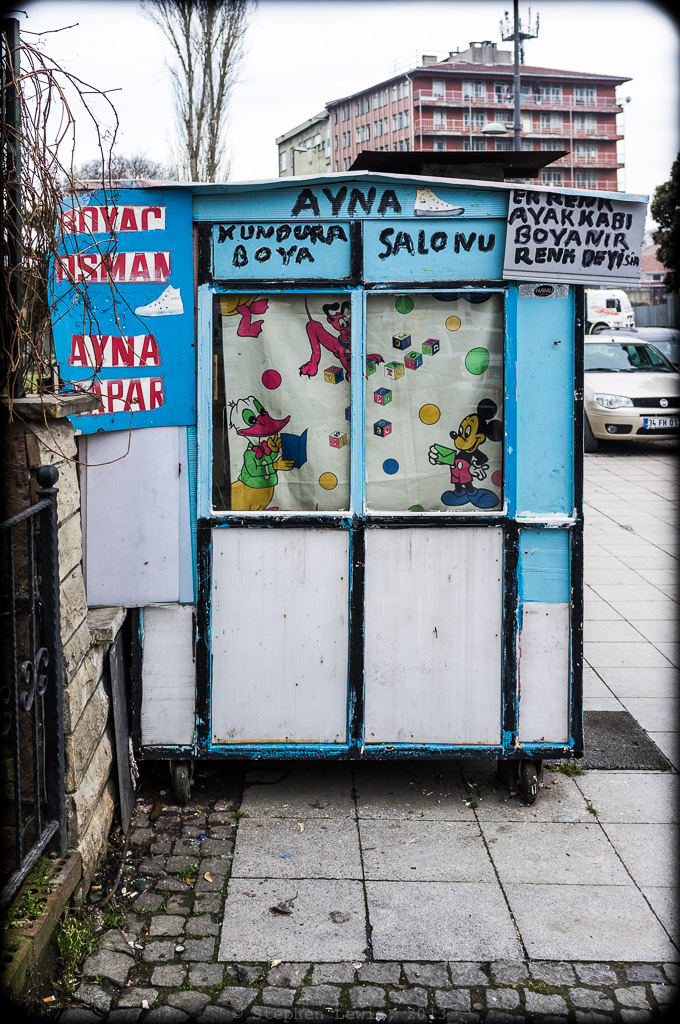
Shine Osman's "Looking Glass Shine" shoeshine stand, Kasım Paşa, Istanbul, 2013. Note the minimal footprint, functional design, recycled materials, and curious Donald Duck, Goofy, and Mickey Mouse themed curtains. (Fuji X100) Click to enlarge.

“Shine” Osman’s “Looking Glass Shine” shoeshine stand, Kasım Paşa, Istanbul, 2013. Note the modest footprint, functional design, recycled materials, and curious Donald Duck, Goofy, and Mickey Mouse themed curtains. (Fuji X100) Click to enlarge.

The ideal real estate “development”project: A sidewalk shoeshine stand on one the main streets of Kasım Paşa, the mostly religious, mostly working class quarter of Istanbul that numbers amongst its better known sons Turkey’s present prime minister, Recıp Tayip Erdoğan.  The structure comprises a minimal intrusion into public space.  Its form is dictated by its function and by the materials at hand.  The business itself is geared to the needs and flows of the pedestrians traffic that passes it.  The Romany origins of the proprietor point to a wealth of lessons about urban sustainability that remain to be learned from the past and present roles of urban Roma.  More on this in a future post …

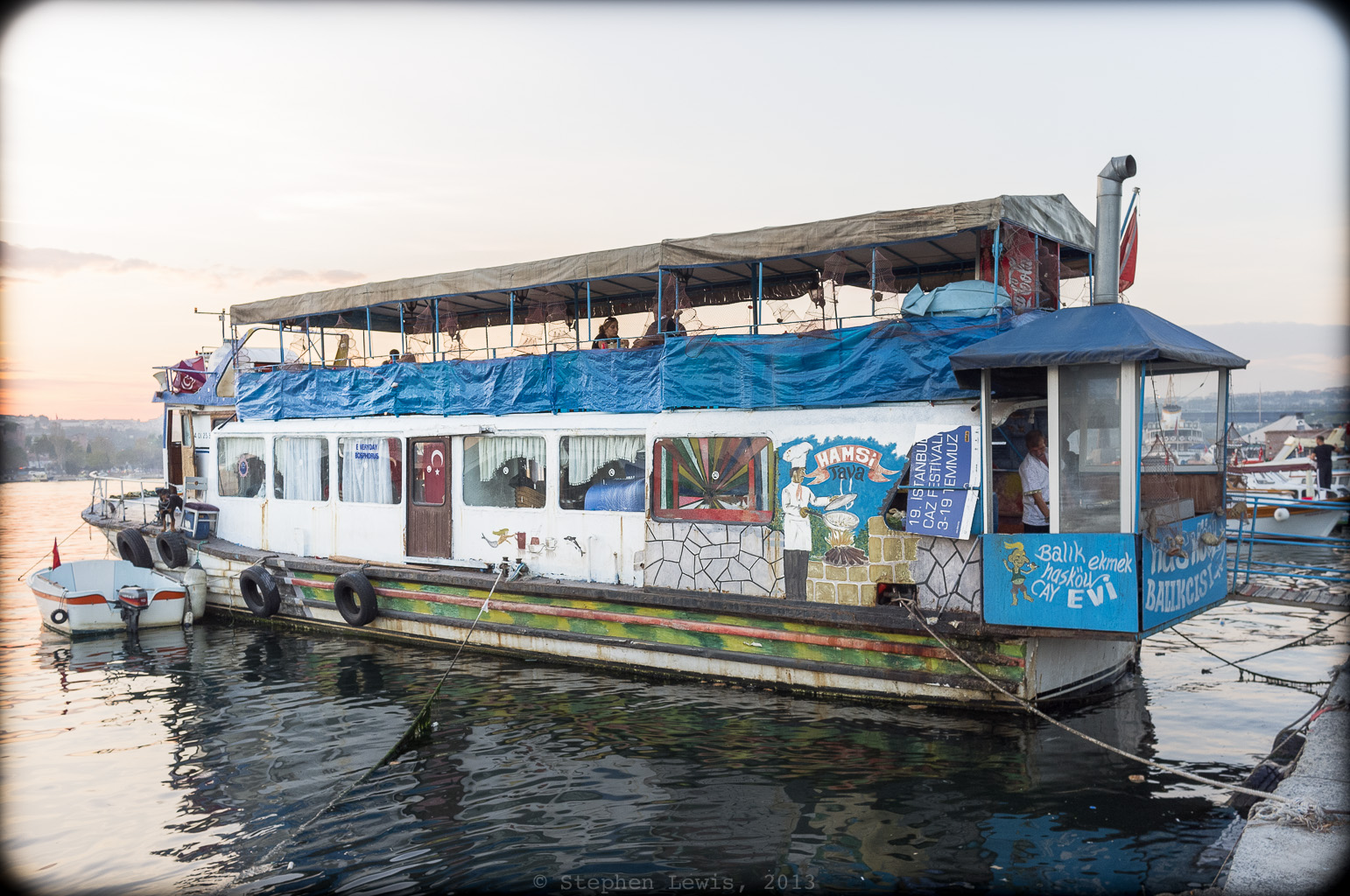
An anchored boat converted to a fish sandwich and fried anchovy restaurant, Golden Horn, Hasköy, Istanbul, 2013.  Note the kitchen topped with jaunty chimney  perched precariously in the after-fitted poop-deck. (Fuji X100)  Click to enlarge.

An one-time small urban ferry converted to a fish sandwich and fried anchovy (hamsi) restaurant, moored on the shore of the Golden Horn, Hasköy, Istanbul, 2013. Note the kitchen and its jaunty chimney perched precariously in an after-fitted poop-deck. (Fuji X100) Click to enlarge.

Further to a previous post on Gezi Park, Istanbul street vendors, etc.

One of the concepts that has stuck with me from my long-ago graduate training is in the form of a concisely worded dictum that continues to prove its veracity over and again in scores of cities worldwide.  I’ve forgotten the precise wording and source, but the  paraphrase that follows is faithful to original: “The economy of a city is dependent on a continuous supply of declining housing stock.”

Hirschman

The concept, it turns out, comes from the works of economist Albert 0. Hirschman.  There has been a recent revival of interests in Hirschman’s life, professional accomplishments, and thought.  The publication earlier this year of a biography of Hirschman brought in its wake articles and reviews in the New York Review of Books, the New Yorker, and the New York Times.  The course of Hirschman’s life — childhood in Berlin, anti-Nazi activist, volunteer in the Spanish Civil War, smuggler of Jewish refugees out of Vichy France, victim of the McCarthy era in the US, specialist in international development, resident scholar at Princeton — is as fascinating as his economics, the latter a non-ideological pragmatism, literary rather than econometric in method, that side-steps master plans to find opportunities in seeming negativities and value in seeming dysfunctions.

The Power of Decline

Declining housing (and commercial) stock provides shelter for those on the way up and those on the way down.  It enables the solvency of those who do heavy-lifting and work at the edges of economies, those very people without whom neither industrial not service economies can function.  It provides affordable locales for cultural renewal and technological innovation.  It provides space for new sectors and enables older sectors — and the employment they provide and skills they preserve — to survive.  It contributes to the social interaction and proximity to others who are different than one’s self that is central to democracy. For generations, the agglomerations of flexible, high value-added, small enterprises that grew around the entrepot functions of cities such as New York had been dependent on re-purposed inexpensive physical plant.

Afterthoughts: From Istanbul to Harlem

  • Apropos of the recent protests in Istanbul, as treated in a number of past posts below, opportunities for incremental reuse contribute far more to social and political cohesion than do the seizing of public space and the razing of viable structures and neighborhoods to make way for massive development projects driven by political cronyism and the financial self-interests of investors and design-driven megalomania of architects.
  • As we see from the photo above, ample supplies of underutilized urban coastline also contribute to the mix of seeming negatives that Hirschman would encourage looking at afresh — likewise with ample supplies of declining boat stock!
  • Last, for a few words on the negative impact of sudden “upscaling” of a a viable and creative neighborhood many of the strengths of which was rooted in its state of perpetual decline, click here for a piece I wrote some years ago mourning the closing of the old Reliable’s Cafeteria and its upscale sister, Copeland’s Restaurant, on West 145th St. in New York City’s Harlem.
Anchors, Cables, Ropes. Perșembe Pazarı, Galata, Istanbul, 2011.  The waterfront site of Perșembe Pazarı (The Thursday Market) has housed the workplaces of ships' chandlers for more than a millennium.  (Toyo field camera, Rodenstock135mm f5.6, medium format color negative in 6x9cm back). Click to enlarge

Anchors, Cables, and Ropes. Perșembe Pazarı, Galata, Istanbul, 2011. The waterfront site of Perșembe Pazarı (The Thursday Market) has housed the workplaces of ships’ chandlers and hardware makers for more than a millennium. (Tripod-mounted Toyo field camera, Rodenstock135mm f5.6, 6x9cm roll film back, drum scan of color negative). Click to enlarge

Some “meta-reporting” further to my recent post entitled Istanbul Conflicts From Afar: Issues and Aspersions, Headscarves and Rambo

Kudos and “Great Expectorations”

Over the past two weeks Istanbul Conflicts From Afar received some attention and even kudos.  On July 10, WordPress (the hosts of Bubkes.Org) featured the post in their “Freshly Pressed” listing of read-worthy blog activity.  On July 20, Doc Searls of the Berkman Center for Internet and Society at the law school of Harvard University included it in a string of quotes summarizing a selection of my postings to date.  More important, Doc  tracked down the US Public Radio broadcast (“Great Expectorations”) that revealed the suspect origins of the malicious and overused “spat upon Vietnam vet” urban legend.  To read the full transcript of the the broadcast click here.

Linux Journal and Working Class New York

By coincidence, only a few days before Doc posted his review of Bubkes.Org, I received an email from the urban, water, and infrastructure expert mentioned in my post Istanbul: Water, Fountains, Taksim, and Infrastructural Tourism.  In his email, the expert included this link to another mention of me by Searls in a 2008 piece for Linux journal.  In the 2008 article, Doc referred to a posting to my old weblog Hakpaksak in which I quoted from Joshua Freeman’s excellent book Working Class New York on the appeal of what remains of the unique character, ethos, and capabilities of New York City as it was prior to the rise and fall of the financial sector.  The collision of the New York of heavy lifting and manual skills with the New York of trading floors and computer screens remains for me a subject of ongoing observation that colors my portrayals, written and photographic, of cities my native New York, Istanbul, and my very own private bench-scale urban laboratory of sorts: Sofia, Bulgaria.

Scrap dealers' handcarts parked and at rest, Tepebaşı, Beyoğlu, Istanbul, 2012.  (Fuji X100) Click to enlarge

Scrap dealers’ handcarts parked and at rest, Tepebaşı, Beyoğlu, Istanbul, 2012. (Fuji X100) Click to enlarge