Archive

Public Space

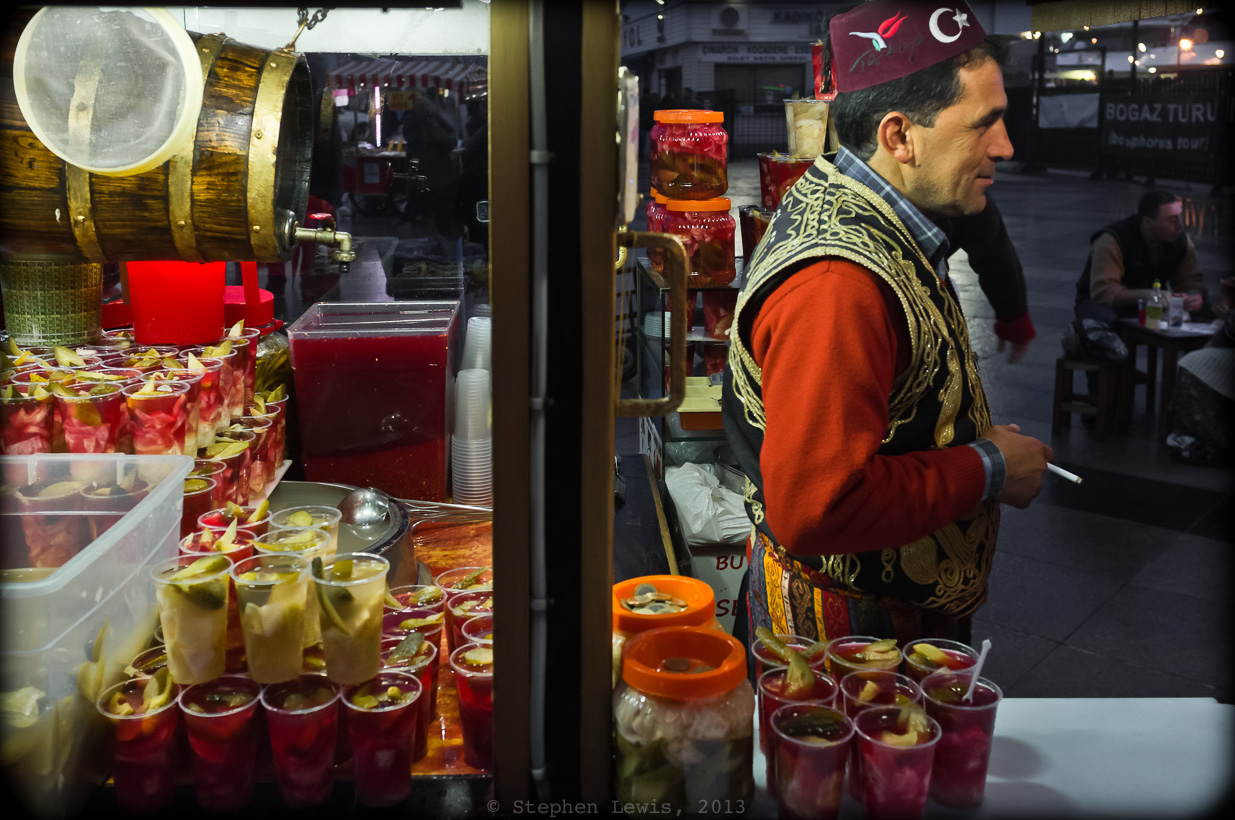
Pickle and pickle-juice vendor with stand prepared for the evening's trade, Eminönü, Istanbul, 2012. (Fuji X100). Click to enlarge.

Pickle and pickle-juice vendor with wares prepared  in advanced for the evening’s trade, Shore-front of the Golden Horn, Eminönü, Istanbul, 2012. (Fuji X100). Click to enlarge.

Invented Traditions

Over the last fifteen years or so, I’ve leisurely waded through the canon literature of the study of the emergence and solidification of nations and national identities: Benedict Anderson’s Imagined Communities, Eric Hobsbawm’s Invented Traditions, Pierre Nora’s five-volume study of the national memory of France, Patrick Geary”s The Myth of Nations, and, most recently,  Timothy Snyder’s powerful studies of identity and hegemony in Eastern Europe (Reconstructed Nations, Bloodlands, etc.), works that illuminate the translation of contrived national identities into viciously exclusionary and expansionist nation states.

A by-product of this reading is the realization that most “national” traditions — be they architectural, musical, dance, culinary, sartorial, folkloric, etc. — are either blatantly invented or appropriated from  traditions shared in common with neighboring peoples in an attempt to establish the legitimacy and hegemony of one’s own group at the expense the identity and power of others.  Invariably, such traditions are posited as being products of an imagined national “golden age.”

Pickles and Mackerel

So, what does the disquisition above have to do with pickles and grilled mackerel in Istanbul?

First, note  the costume worn by the pickle vendor in the photo at the top of this post:  a) an imitation fez made of cheap velvet rather than traditional wool felt, and emblazoned with the Turkish national crescent and star and with a stylized tulip, the latter a logo thought up for Turkey’s national tourism authority by a PR or “branding” agency; b) a mass produced embroidered vest of the sort sold to tourists in souvenir shops and bought in bulk by amateur folk-dance troupes; and c) a brightly colored waistband over wide pantaloons (the latter not visible in the photo).

A decade ago, the very same vendors dressed in normal street or work clothes and the carts from which they were sold were simple affairs of glass panes and unfinished or laminated wood.

At the water's edge: Neon-lit canopied faux-traditional caiques, floating kitchens preparing and serving grilled mackerel sandwiches to passersby. In the foreground, an angler in search for his own dinner. Illuminated in the far distance, the Süleymaniye, the mosque complex of Sultan Süleyman the Law-Giver ("Suleiman the Magnificent"), a master-work of the 16th-century architect Mimar Sinan. Galata Bridge, Istanbul, 2011. (Fuji X100). Click to enlarge.

Mid-distance at the water’s edge: Neon- and lcd-lit, faux-traditional, canopied launches — floating, wave-tossed kitchens grilling and serving  to passersby mackerel sandwiches garnished with lettuce and onions. In the foreground, an angler in search of his own fish dinner. Illuminated in the  distance, the Süleymaniye, the mosque complex of Sultan Süleyman the Law-Giver (“Suleiman the Magnificent”), a master-work of 16th-century architect Mimar Sinan. Galata Bridge looking across the mouth of the Golden Horn towards Eminönü, Istanbul, 2011. (Fuji X100). Click to enlarge.

Second, note the boats of grilled mackerel vendors moored at mid-distance in the second photo above.  The boats are topped with canopies in the shape of stylized fantasy imitations of those that once adorned the excursion launches of the Ottoman elite — with the addition of multicolored neon and incandescent lighting.  A decade ago, such boats were plain wooden skiffs with simple canvas or plywood roofs to block seasonal sun and rain.

I don’t remember exactly in which year this “make-over”of pickle vendors and mackerel boats occurred, nor am I certain why and at whose behest.  My guess is that it was mandated by the local district municipality or by the tourism functionaries of the municipality Istanbul.  More interesting is why ….

Read More

An infrastructural question: Will seaside boardwalks survive the 21st century?

A look at the New York region suggests that they might not.  The resurgence of nature over urban artifice during last year’s Hurricane Sandy revealed anew the importance of regeneration and/or conservancy of natural coastlines.  The flooding that devastated nearby Long Beach on the south shore of Long Island, for example, would have been avoided or minimized had natural sand dunes still been in place that were removed early in the twentieth century to clear the way for apartments with oceanside frontage and the construction of a magnificent miles-long boardwalk promenade.  This year’s fire to the south of New York City on New Jersey’s Atlantic shore owed its rapid spread to the very materials that give boardwalks their name: wood-plank paving.   And, yet, boardwalks remain urban necessities.

Shuttered monument to a forgotten Brooklyn politician: Abe Stark Sport Center, Boardwalk, Coney Island-Brighton Beach, 2011. (Fuji X100)

Shuttered monument to a forgotten Brooklyn politician: Abe Stark Sport Center, Boardwalk, Coney Island-Brighton Beach, 2011.(Fuji X100.)  In the foreground: the characteristic herringbone wood planking of New York City boardwalks and a lone dented trash barrel painted in the signature green of the NYC Dept. of Parks.

From fashion to survival

Boardwalks are products of the interstice of 19th-century romanticism and 19th-century urbanity, in which nature was a picturesque backdrop to be seen but not touched, to be witnessed — but with dry and unsoiled shoes — from the safety and elegance of seaside promenades and beach-front hotels and restaurants. In the context of the lives of millions of ordinary New Yorkers — this writer and two generations of his forebears included — the boardwalk at Coney Island was and remains central to urban survival.   Like Manhattan’s Central Park and Brooklyn’s Prospect Park, the Coney Island boardwalk from Brighton Beach past Coney Island to Seagate gives New Yorkers who lack the means to vacation or to travel afar access to fresh air and a refuge from urban congestion and searing summer heat.

Outlets to the sea

The Coney Island boardwalk was built ninety years ago, a time when the farmlands of Brooklyn were being paved over en masse for the construction of seemingly endless expanses of working- and lower-middle-class apartments for immigrants and their children fleeing cramped, degrading housing conditions in lower Manhattan.  Their flight followed the paths of newly built subways lines, trajectories that gave also gave shape to the schemes of real estate speculators.   The continuation of subway lines to the seaside, and thus to Coney Island, afforded the urban working poor an easy outlet to the beach and to walks and leisurely socializing on surfaces less oppressive than urban concrete, and to sounds less intrusive than the ever-present rattling of horse carts and, later, the roar of automobiles.

Changing numbers, changing faces

Over the last century, usage of the Coney Island boardwalk has fluctuated in parallel with the fortunes and changing demographics of its immediate hinterland.  (A lengthy subject that I will save for future posts.)  The apogee of the boardwalk’s crowds and popularity was in the 1930s and early 1940s.  A decline set in after the Second World War and continued through 1970s.  A revival was sparked in the late-1970s, in part by the settlement in Brighton Beach of tens of thousands of mostly Jewish immigrants from the Soviet Union.  Over the past decades, the faces seen, and accents and languages heard, along the boardwalk have changed from those of Jews, Irish, and Italians — once amongst the dominant ethnic groups in New York — to those of African-Americans, Puerto Ricans and Dominicans, Russians, Central Asians, Indians, Pakistanis, Mexicans, and Chinese.  What has remained constant is the precarious place of boardwalk denizens towards the lower rungs of New York City’s housing and economy.

From infrastructure to serendipity

During the 1930s and early-40s, under President Roosevelt’s New Deal and the mayor-ship of Fiorello LaGuardia, investment in and maintenance of public infrastructure, both physical and social, was seen as a core task of government – – a means for collectively facilitating the lives and advancement of all individuals comprising our society and, not least, ensuring social peace in the process.  Parks, beaches, and boardwalks included, were parts of the mix.

America's shoreline: John"s Italian Ices and a tattered US flag. Sunset at the Coney Island Boardwalk, 2011. (Fuji X100)

America’s shoreline: John”s Italian Ices and a tattered US flag. Sunset at the Coney Island Boardwalk, 2011. (Fuji X100)

“Fast forward” to the years of New York as financial center and the Bloomberg years, the age of a real-estate-development-driven economy, increasing unequal distribution of wealth, and “Manhattanization” (a new phrase coined to describe the phenomenon of a economically and demographically variegated city or part thereof suddenly turning into a preserve of those at the upper income levels, this a la the fate of much of Manhattan since the start of the millennium).

Over the last decade, social and physical infrastructure and their maintenance are increasingly surrendered to private enterprises or left to the serendipitous voluntarism of “public private partnerships.”   One of the results has been the filleting of the public funds for parks maintenance and the establishment in place thereof of “public-private partnerships” in the form of “conservancies” linked to individual properties.  The outcome has been predictable.  Manhattan’s Central Park, the city’s highest profile park facility, flanked by three of New York’s wealthiest district is governed and funded by a conservation with an immense endowment and budget.  Brooklyn’s Prospect Park Conservancy struggles to cover costs and many of the parks facilities still dependent on filleted public funds languish.

“Let them walk on concrete:”

Wood paved boardwalks splinter, warp, and rot, they are maintenance intensive and require periodic resurfacing.  In the spirit of Marie Antoinette advising the bread-starved poor of pre-revolutionary Paris  “… let them eat cake,”  the Bloomberg era’s prescription for the patrons of the Brighton Beach-Coney Island boardwalk appeared to be: “… let them walk on concrete.”   A couple of years ago, large sections of the boardwalk surface were stripped of their wood and replaced by prefabricated modular sections of light-colored concrete with surfaces crudely textured to give the impression of wood grain.  The modular sections were poorly leveled and sloppily abutted.

The immediate reaction?  Small crowds of boardwalk denizens gathered in amazement and  Read More

A Brighton Beach sabbath afternoon. Ultra-orthodox Jews gazing at volley ball and the horizon; Brighton Beach, Brooklyn, New York, 2012. (Fuji X100). Click to enlarge.

A Brighton Beach sabbath afternoon. Ultra-orthodox Jews gazing (longingly?) at a volley ball game and the sand, sea, and horizon; Brighton Beach, Brooklyn, New York, 2012. (Fuji X100). Click to enlarge.

Note the prefabricated concrete boardwalk surface, grained in a half-hearted attempt to simulate the traditional wood plank surface — more on this in a subsequent post.

Ticket taker, dance event, Coney Island, 2012. (Fuji X100). Click to enlarge.

Ticket taker, dance event, Coney Island, 2012. (Fuji X100). Click to enlarge.

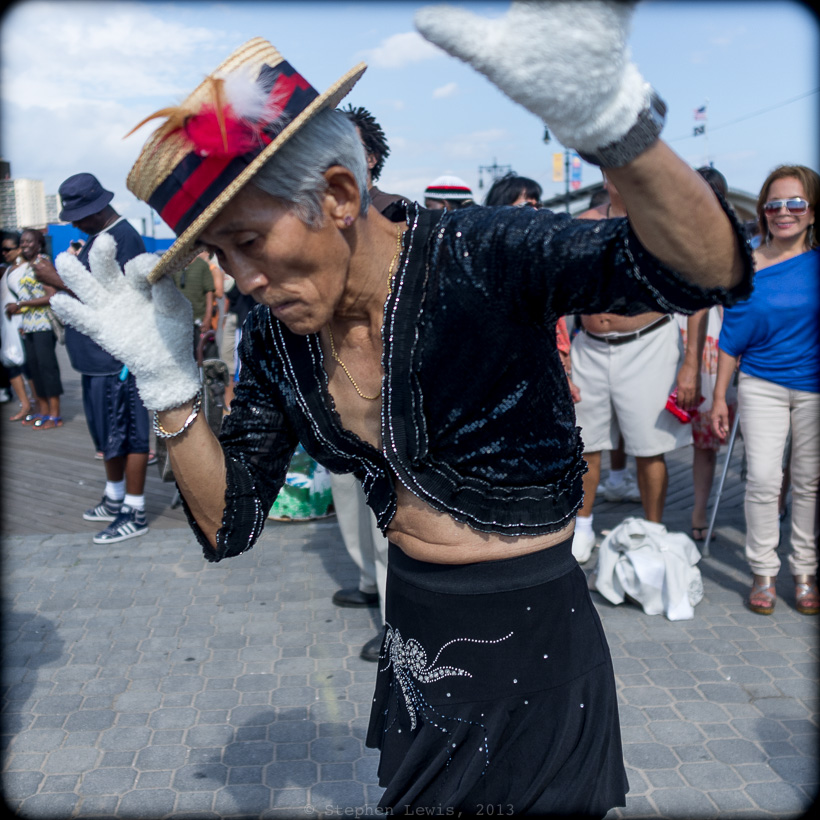
Two Coney Island boardwalk dance event denizens. In the absence of my Rolleiflex, the photos were composed and later edited to square format

Solitary "hoofer," Coney Island, 2012. (Fuji X100). Click to enlarge.

An introspective, sequined “hoofer” in the midst of a complex dance step, Coney Island, 2012. (Fuji X100 w/ 28mm-equivalent adaptor). Click to enlarge.

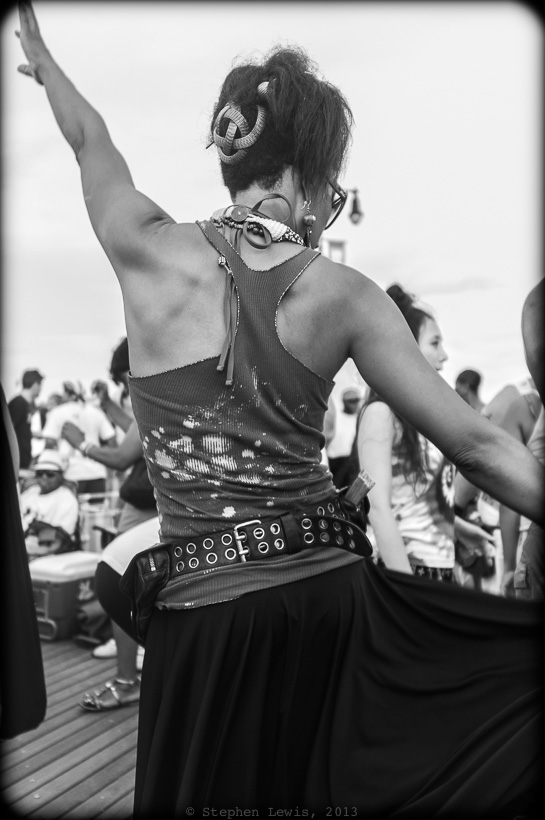
Dancers at a weekend afternoon dance party, Coney Island Boardwalk, Brooklyn, New York, 2012. (Fuji X100 w/28mm-equivalant lens adapter). Click to enlarge.

Weekend afternoon dance party, Coney Island Boardwalk, Brooklyn, New York, 2012. (Fuji X100 w/ 28mm-equivalent lens adapter). Click to enlarge.

I haven’t gotten out to Coney Island this summer.  So, offhand, I don’t know the state of the famed Coney Island-Brighton Beach seaside boardwalk post-Hurricane Sandy.  What I do know is that I very much miss dancing on Coney Island boardwalk in the breeze and fading light of weekend summer afternoons.

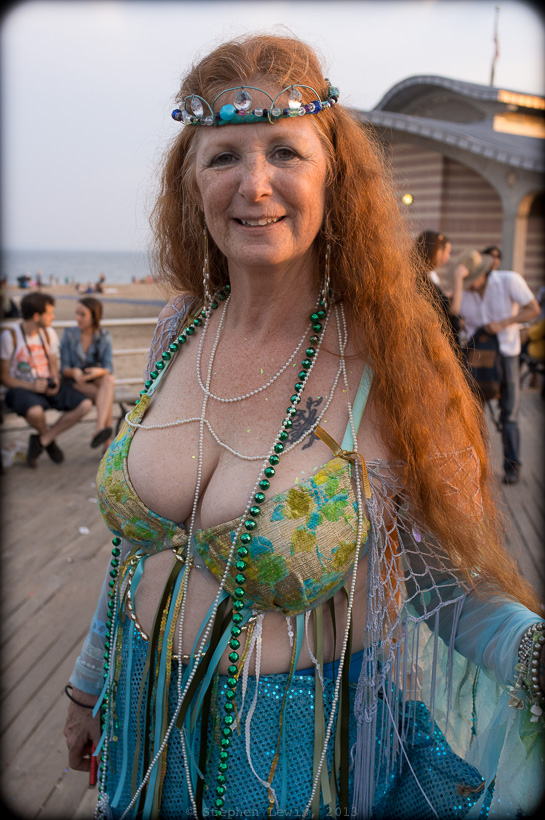
For the last couple of decades, impromptu dances set to the blare of portable sound systems and music decks manned by proprietors and patrons of boardwalk bars attract a crowd of dancers representative of New Yorkers to whom Coney Island is the only affordable and accessible seaside respite from the thick air, stuffy apartments, and burning pavements of summer time New York.  (This despite the efforts of former mayor Giuliani to expunge such offenses against “quality of life” and of soon-to-be-former mayor Bloomberg to sanitize, gentrify, and recycle neighborhoods and public space for the benefit of those with high incomes and volumes of disposal cash.)

Most Coney Island boardwalk dancers are urban survivors, people who’ve made it through the scourges of low-paying jobs or lives at the edge.  The music is mostly Afro-Caribbean, Latin, and fusion.  The price of a ticket is no more than a lack of pretension and a desire and ability to dance.

These last years, I’d gravitated more and more towards to weekend dances on the boardwalk.  The grit of the edge of the city is more redolent of the New York that shaped me, and the boardwalk venue is far more familiar, accessible, and welcoming to me than are stylish clubs in upper income Manhattan or in the ethnically-purged, middle-American “hipster” neighborhoods that now sprawl across the north of Brooklyn. Not least, the subtle flexibility and responsiveness of the boardwalk’s wood plank surface add spring and an intoxicating feeling of (seeming) virtuosity to one’s every step.

More Coney Island dancers! (Specifications as per photo above) Click to enlarge.

More Coney Island dancers. (Specifications as per photo above) Click to enlarge.

Technical Footnote

On the X100, the  optical imperfections (softness, flare, and color casts) of Fuji’s 28mm-equivalent screw-in wide angle adaptor helped rather than hinder portrayal of a Coney Island weekend afternoon.

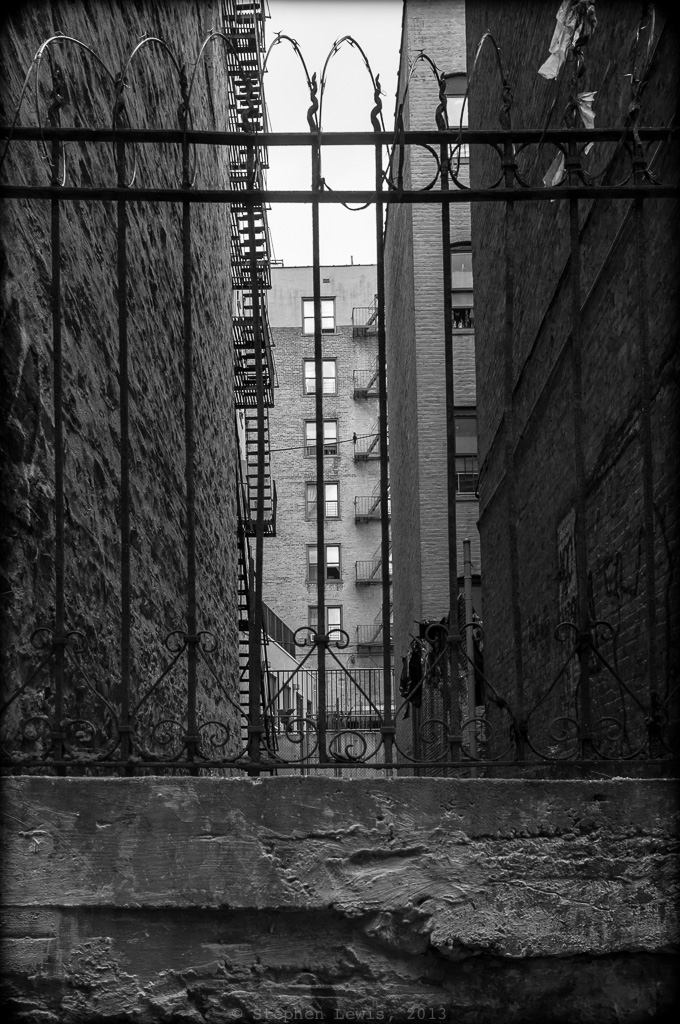
Courtyard, near Anderson Ave., West Bronx, 2012.  Note the traditional New York City fire escapes and the razor wire atop the original wrought iron fencing. (Fuji X100) Click to enlarge.

Rear courtyard, near Anderson Ave., West Bronx, 2012. Note the traditional New York City fire escapes mounted on the walls and the razor wire atop the original wrought iron fencing in the foreground. (Fuji X100) Click to enlarge.

In the 1920s and 30s Art Deco facades came to define the face of the west Bronx but, for decades, it was the unadorned rear courtyards and fire escapes of the very same buildings embodied the raw life of the neighborhood. Fire escapes served as balconies, summer sleeping quarters, laundry racks, improvised gardens, and winter-time ice boxes.  Socially, they were settings for family dramas and neighborly dialogues from the mundane to  a theatricality worthy of Ben Hecht or Clifford Odets.

A half century ago, the construction of Robert Moses’s Cross Bronx Expressway cut a ghettoizing east-west slash across the Bronx, isolating the southern half of the borough. This and New York’s tough, dangerous, drug years of the 1970s turned Bronx courtyards from domains of life to domains of danger. Will the present decade see the removal of razor wire or its reinforcement and expansion?  Will it bring the integration of this magnificent neighborhood into citywide trends or its continued marginalization?  Will it fall victim to gentrification or the “cool” settlements of “hipsters” that have “ethnically-cleansed” darker skinned, lower income, and gray haired folks from large swaths of Brooklyn? Comments are welcome.

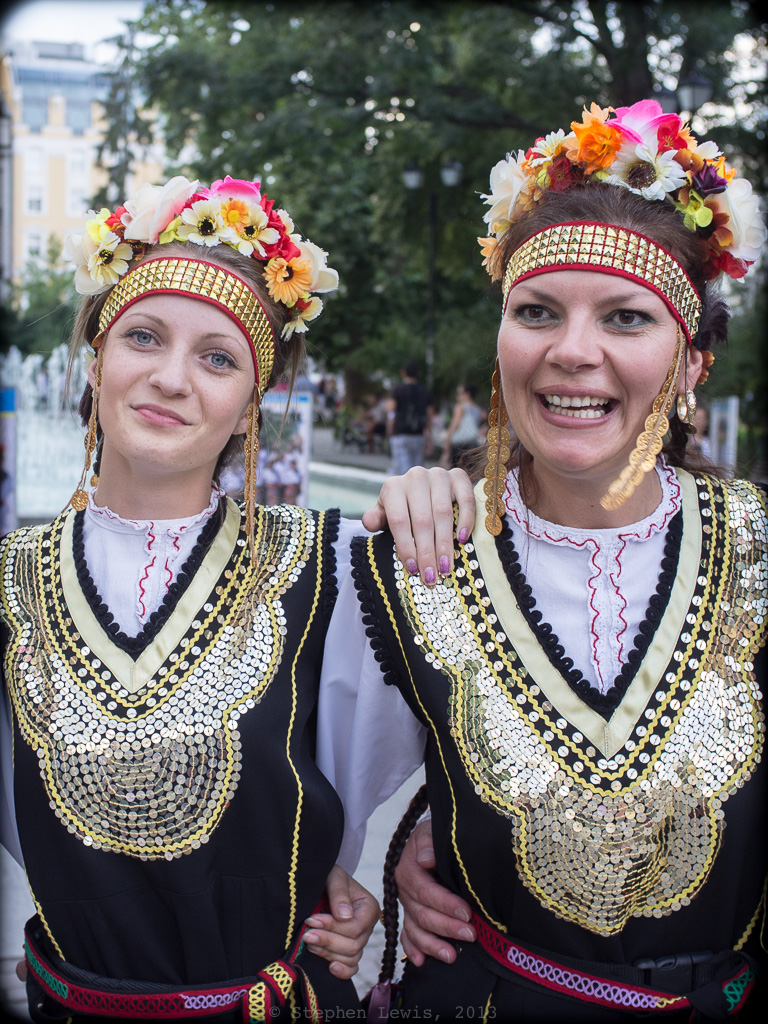
Two members of an amateur folk dance troupe following a performance at an outdoor dance event for children, downtown Sofia, Bulgaria, 2013. (Fuji X100, vertical crop from horizontal frame) Click to enlarge.

Two traditionally-costumed members of an amateur folk dance troupe following a performance at an outdoor dance event for children, downtown Sofia, Bulgaria, 2013. (Fuji X100, vertical crop from horizontal frame) Click to enlarge.

For a quarter of a century, Sofia, Bulgaria has been my bench-scale urban laboratory of sorts, a city like any other but more compact and with an accelerated pace of change.  Sofia has served me as a lens through which to view dynamics of my native New York and other cities in which I spend time and  work —  cities  diverse in size, histories, and issues facing them, from sprawling, dense Istanbul to tiny, prosperous Luxembourg.

A Shift Away From the Urban Core

In the years since the 1989 collapse of the Soviet Bloc, Sofia has passed through a century’s worth of change.  Migration from villages and towns led to a near trebling of its population. In the initial decade after “the changes,” former apartments and single-car garage spaces in Sofia’s downtown became  incubators of small businesses and even smaller shops, cafes and bars  Later, enterprises that grew migrated to new, purpose-built agglomerations outside of the urban core. Simultaneously,  a new middle class moved to villas, apartment buildings, and gated “communities” at the urban periphery. Sofia’s Soviet-era high-rise concrete panel residential neighborhoods took on new life and developed their own entertainment and retail functions. Giant shopping malls sucked retail activity and pedestrian flows off of downtown streets. Motor vehicle and public transportation traffic shifted from converging on the urban core to traversing it. Amongst the results: For a number of years, Sofia’s Jugendstil- and Bauhaus-inspired downtown took on a derelict and depopulated look, becoming the seeming province of the older and the less successful by day and exuberant lower-end bar goers by night.

Street Fairs and Smiles

This summer, I’ve noticed surprising hints of change.  Downtown parks are newly landscaped and planted.  Street events generic to European and American cities — concerts, street fairs, and dance — now occur.  Tourist guides lead groups of foreigner through streets whose history they have barely begun to scratch.  And, recent political protests have had the spill-over effect of attracting  evening strollers to downtown streets.

The photo above was taken in the garden of Sofia’s  “Ivan Vazov” National Theater, following a dance event for children.  I know neither the names of the two dancers nor of their ensemble, but their smiles and confidence seem to auger well for the future tone of downtown Sofia — but, then again, in Sofia, one is never quite sure!

Concrete apartment houses awaiting demolition, Haseki quarter, Istanbul, 2013. (Fuji X100) Click to enlarge.

Gerry-built concrete apartment houses awaiting demolition, Haseki quarter, Istanbul, 2013. (Fuji X100) Click to enlarge.

The unintentional geometry and textures of urban surfaces in a neighborhood under renovation.  No additional words needed.

Shadows cast by domes and chimneys of a 16th-century Imaret (hostel structure), Haseki quarter, Istanbul, 2013. (Fuji X100) Click to enlarge.

Shadows cast by domes and chimneys of a 16th-century Imaret (hostel), Haseki quarter, Istanbul, 2013. (Fuji X100) Click to enlarge.